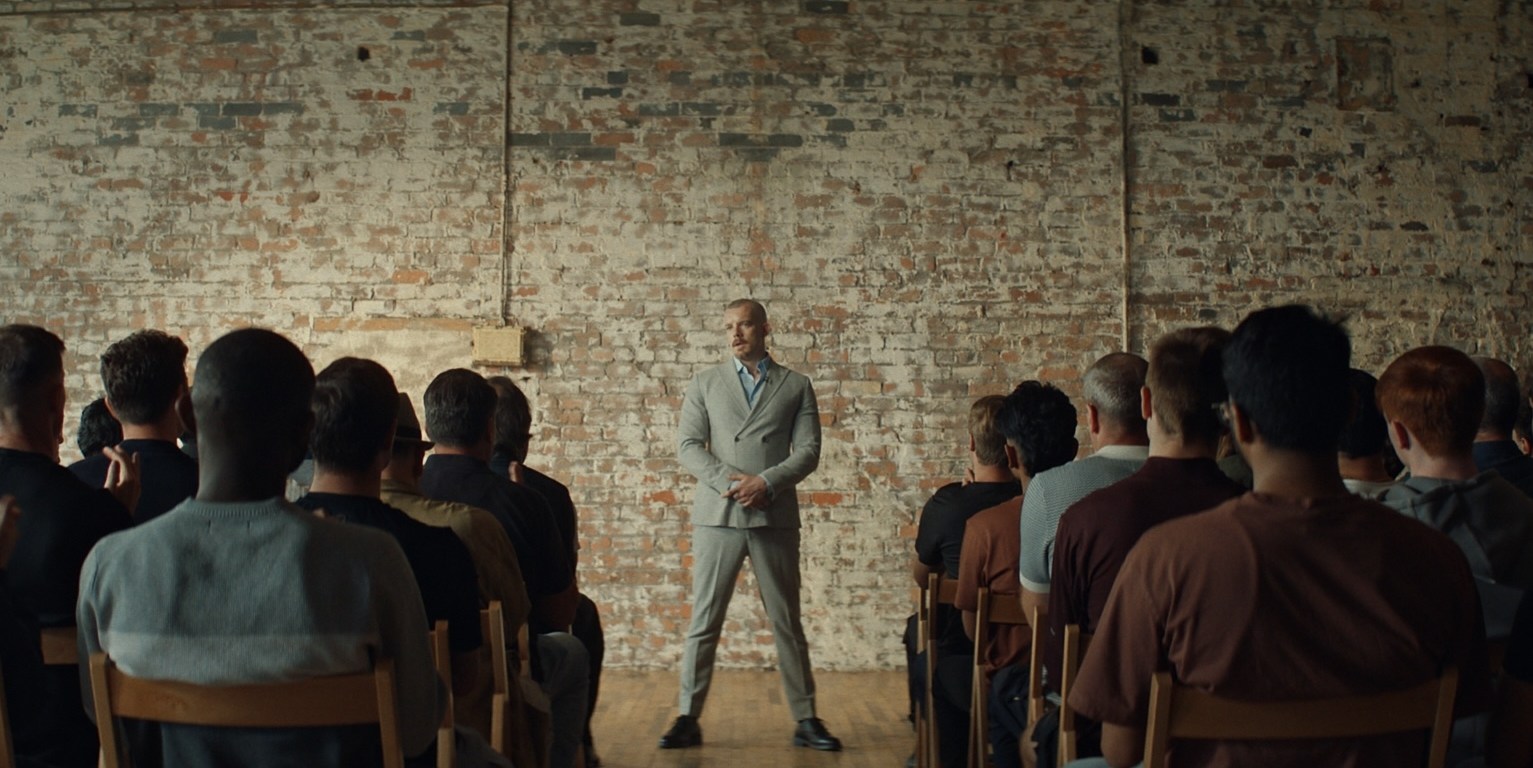
From the seductive promises of online self-help culture to the increasingly complicated expectations surrounding contemporary masculinity, writer-director Sai Karan Talwar explores the fragile relationship between identity, influence and control in I AM THE PRIZE, an Oscar-qualified short film starring Russell Tovey.

Examining the psychological contradictions of a charismatic self-help figure, I AM THE PRIZE, from writer-director Sai Karan Talwar, asks uncomfortable questions about the people we choose to follow, the identities we perform and the price of maintaining an image of perfection.
At a time when social media personalities increasingly position themselves as authorities on success, relationships and masculinity, the film examines how easily the language of empowerment can become a mechanism for manipulation. At its centre is Anthony Selvon (Russell Tovey), a charismatic self-help figure who has built his public identity around certainty, authority and a particular vision of masculinity. But when an interview threatens his ability to control the narrative, the contradictions beneath his carefully maintained image begin to emerge.
For Talwar, the inspiration came from an interest in how the self-help industry increasingly exploits people’s insecurities and desire for belonging. “We live in a culture that tells people they can become the best version of themselves, but that message can also be weaponised,” he explains. “Particularly online, there are figures who recognise people’s insecurities and offer them a very specific version of success, masculinity and identity in return for their loyalty.”
Rather than making a straightforward exposé of a fraudulent guru, Talwar wanted to explore the psychological complexity of individuals who can be simultaneously persuasive, vulnerable and manipulative. “What interested me wasn’t simply the idea of a self-help guru being exposed as a fraud. It was the psychological contradiction at the heart of these figures: they can be incredibly persuasive because they understand something real about the people they’re speaking to.”
When Empowerment Becomes Manipulation
A central concern of I AM THE PRIZE is the distinction between genuine personal development and systems designed to create dependency. Talwar is careful not to dismiss the self-help industry entirely, recognising that people need guidance, community and purpose. The problem arises when those offering support begin positioning themselves as the only people capable of providing answers.
“I think the distinction comes down to whether the person offering guidance ultimately empowers you to think for yourself or makes you increasingly dependent on them,” he says.
Manipulation, he observes, rarely announces itself. It can be packaged as discipline, mentorship or tough love, making people feel understood even as their independence is gradually eroded. This ambiguity informed the creation of Anthony, whose appeal needed to feel believable for the audience to understand why people would follow him.
Talwar also wanted to resist portraying Anthony as an uncomplicated villain. While the character exists within a culture that rewards confidence over competence and spectacle over substance, he remains responsible for his decisions.
“I’m more interested in the uncomfortable question of how ordinary human needs can be exploited by someone who knows exactly how to appeal to them,” the director explains.
The film’s title reflects this contradiction. Borrowed from the language of self-optimisation, I AM THE PRIZE initially sounds like an affirmation of personal worth. Yet Talwar was interested in the ego and entitlement that can sit beneath such a declaration.
“There’s an interesting contradiction in telling people that they should recognise their own worth while simultaneously teaching them to measure that worth through dominance, desirability, status and the validation of others.”
For Anthony, the title becomes both a declaration and a question. “Is he the prize, or does he need the audience to keep telling him that he is?”
The Man Behind the Performance
The film’s exploration of masculinity gives its subject particular contemporary relevance. Talwar is concerned by a culture increasingly telling men that they must be dominant, financially successful, emotionally invulnerable and permanently in control.
“I think we’re increasingly confusing masculinity with performance,” he observes. Vulnerability is framed as weakness, empathy becomes something to distrust, and relationships can become transactional.
At a time when many young men are searching for identity, purpose and belonging, Talwar believes some of the loudest voices offering answers are also profiting from that uncertainty. His film challenges these assumptions by examining the fragility beneath the performance.
“For me, there’s a difference between genuine strength and the constant need to prove that you’re strong. I think the former requires a degree of self-awareness and vulnerability that the latter actively discourages.”
This contradiction is embodied in Anthony, whose public identity has become inseparable from his private existence. “I was fascinated by the idea that a person can become so invested in performing an identity that the performance begins to consume them,” Talwar explains.
Anthony’s private life does not necessarily align with the worldview he promotes, but the director is more interested in the psychological cost of maintaining that separation than simply exposing a hidden secret.
“Anthony’s tragedy, if you can call it that, is that he has built a system in which he cannot afford to be fully human.”
Russell Tovey and the Power of the Interview
Casting Anthony required an actor capable of making his charisma convincing while allowing his vulnerabilities to emerge gradually. For Talwar, Russell Tovey was the ideal choice.
“Russell has a remarkable ability to hold contradictory qualities within a performance. He can be charismatic and inviting, but there’s also an emotional intelligence that allows you to sense what might be happening beneath the surface.”
The actor understood that Anthony needed to be someone audiences could genuinely imagine following, rather than an obviously sinister figure. Talwar particularly valued Tovey’s ability to communicate contradictions through subtle changes in expression, behaviour and tone.
The film’s central interview sequence brings these tensions to the surface. Conceived as a confrontation between two competing versions of reality, the scene reverses Anthony’s usual position of authority. Accustomed to controlling conversations and defining the terms of debate, he suddenly finds himself unable to dictate the narrative.
“I was interested in the power dynamics within the scene: the pauses, the evasions, the moments when a question seems innocuous but carries something much more threatening beneath it.”
For Talwar, Anthony’s greatest weapon is language, making it particularly fitting that language ultimately becomes the instrument through which his carefully constructed identity begins to fracture.
“The audience is watching someone who has spent his life telling other people how to live suddenly being forced to confront the contradictions in his own life.”
A Cinematic Language of Observation
Working with cinematographer Joshua Carrington Birch, Talwar developed a visual approach that reinforces the film’s psychological tension. Framing, camera distance and perspective were carefully considered to reflect shifting power dynamics, establishing who commands a space and who is being observed.
Influences included David Mamet, particularly his exploration of deception and power through dialogue, alongside filmmakers Michael Haneke, Ulrich Seidl and Abel Ferrara, whose observational approaches to uncomfortable human behaviour informed the direction.
Long takes were especially important, allowing moments to unfold without offering audiences the relief of an immediate cut.
“The long takes were important because they leave the characters with nowhere to hide. You can’t escape a moment through a cut or a change of perspective; you have to sit with the behaviour and confront what’s happening in front of you.”
The film also represents an important stage in Talwar’s development as a filmmaker. His previous projects, GHANIMAH and WHAT MEN DO FOR LOVE, each provided different creative and technical challenges. The latter, told in a single shot, taught him to trust performances and understand how tension can develop through real-time action.
By the time he approached I AM THE PRIZE, Talwar felt increasingly confident in bringing every element of filmmaking together in service of the story. From performances and cinematography to framing and editing rhythms, each decision needed a clear dramatic purpose.
An International Journey Towards the Academy Awards
For Talwar, having I AM THE PRIZE qualify for consideration for the Academy Awards is a particularly meaningful achievement for an independently produced short film.
“It’s incredibly meaningful. Making an independent short film is already a huge undertaking, so to have I AM THE PRIZE qualify for consideration for the Academy Awards is something I’m very proud of.”
The film’s international journey has also included BAFTA qualification and festival recognition, including nominations at HollyShorts and Frameline, alongside a Best Performance win for Russell Tovey at HollyShorts.
Talwar has been particularly encouraged by the way audiences from different backgrounds have connected with the film. Although its subject matter is rooted in contemporary self-help culture and masculinity, its underlying questions about identity, shame, power and belonging have a much wider resonance.
“What’s particularly interesting to me is that, although the film engages with a very specific contemporary phenomenon, the questions at its centre seem to resonate more broadly.”
He also welcomes the different interpretations that emerge after screenings. Whether audiences see Anthony primarily as a manipulator, a product of his circumstances or some combination of the two, Talwar believes that disagreement is valuable. His intention was never to provide a simple verdict, but to encourage a conversation that continues beyond the film itself.
Looking Beyond the Image
Ultimately, I AM THE PRIZE is about the danger of confusing the image of a person with the reality of who they are. Through Anthony’s carefully constructed identity, Talwar examines a contemporary culture increasingly preoccupied with public perception, personal branding and external validation.
He hopes audiences will question not only the individuals they allow to influence them, but also their own relationship with identity and self-worth.
“It’s easy to look at figures like Anthony and assume that their influence has nothing to do with us. But I think the more interesting question is why their messages resonate in the first place.”
For the director, the film’s central concern extends beyond the self-help industry. It asks how much people are willing to sacrifice to maintain the identities they have presented to the world, and whether the pursuit of becoming someone else can prevent them from understanding who they already are.
As I AM THE PRIZE continues its international journey following its Academy Award and BAFTA qualifications, its subject feels increasingly relevant. In a world where confidence can be mistaken for competence, influence for authority and performance for authenticity, Talwar offers a timely examination of the complicated relationship between who we are and who we want others to believe we are.
His hope is that audiences leave looking beyond the performance, questioning those who claim to have all the answers and approaching themselves and others with greater honesty.
“How much of ourselves are we willing to sacrifice to maintain the person we’ve convinced the world we are?”
I AM THE PRIZE, written and directed by Sai Karan Talwar has qualified for consideration for the 99th Academy Awards.

