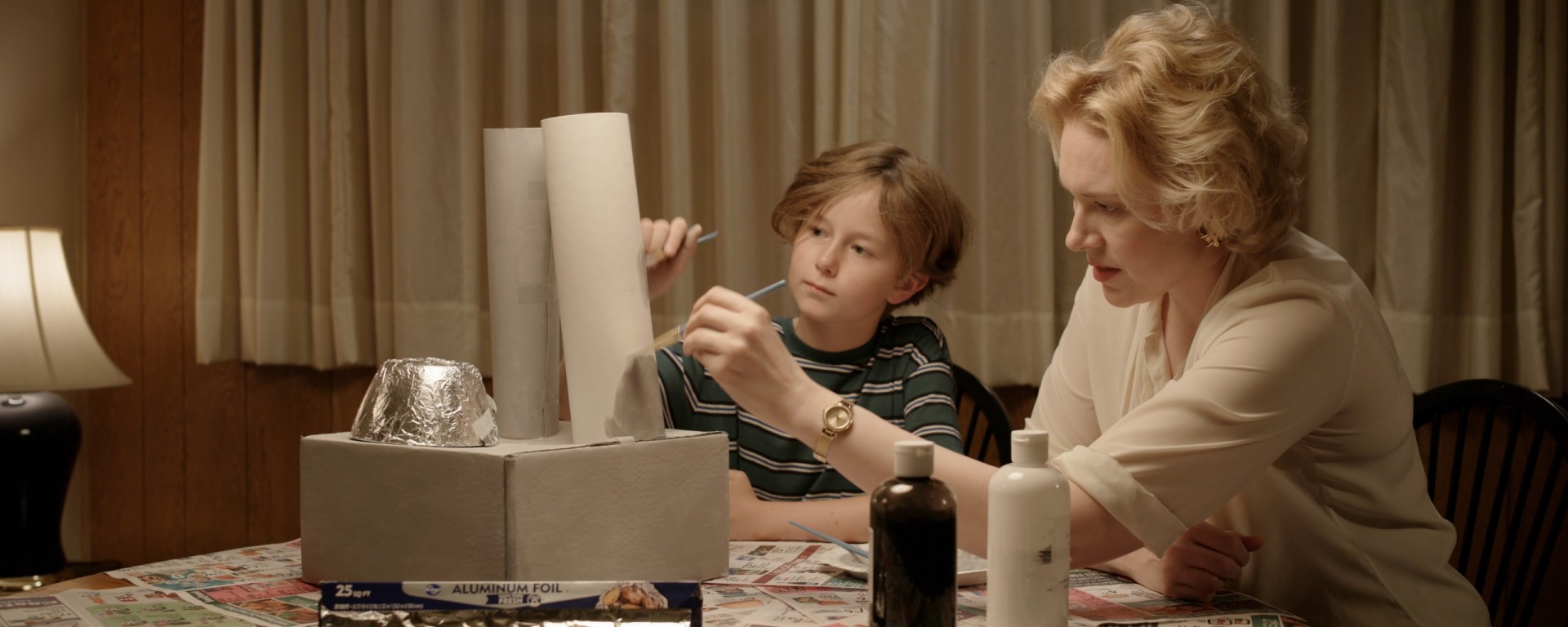
Set in 1989, LAST MINUTE takes the predicament of a homework assignment left until the eleventh hour and turns it into a funny and heartfelt exploration of community, memory and the unexpected value of everyday challenges. Through the story of a single mother navigating her son’s homework crisis, writer-director Michael Cusumano and actor-producer Charity Schubert revisit a world on the brink of technological change, asking what we might lose when convenience begins to replace human connection.
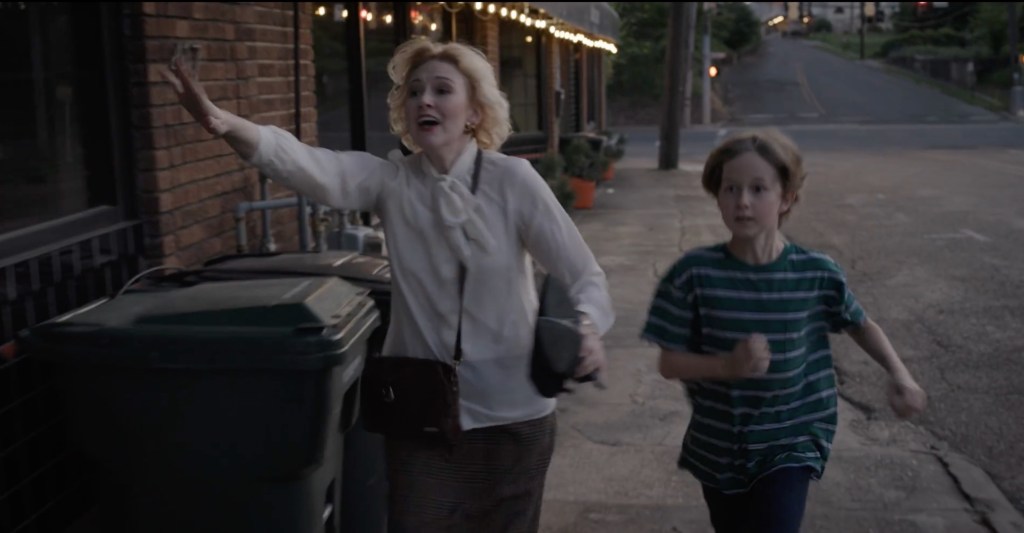
At the centre of the LAST MINUTE is Jackie (Charity Schubert), a resourceful single mother whose evening is thrown into chaos when her 12-year-old son leaves a major school assignment until the last minute. As the clock ticks down, a seemingly ordinary problem draws in friends and neighbours, revealing the unexpected ways that everyday difficulties can bring people together.
For director Michael Cusumano, the inspiration came from a realisation about how much childhood has changed. In 2023, he discovered that his high-school-aged nephews no longer experience snow days because remote learning allows school to continue from home.
“It’s a sobering thought to realize your memories have historical value,” he says. “That you’re a connection to the past in a way that I normally associate with old-timey baseball players in a Ken Burns documentary.”
The memories that followed became the starting point for a story about a time when solving a problem often meant relying on the people around you.
A World Before the Internet
The choice of 1989 was central to the film’s concept. For Cusumano, the period has a particular quality, feeling both recent and distant. His research revealed that America Online existed but had not yet come to market in late 1989, making it an ideal moment to capture a world just before the internet began reshaping everyday life.
“We can sense the Internet looming in the background, ready to make nights like the one in the film disappear, never to return,” he explains.
The filmmakers were keen to avoid turning the period setting into a collection of nostalgic references. Instead, they wanted the era to provide an authentic backdrop while keeping the focus firmly on the characters.
Schubert describes their approach: “We wanted to evoke the period believably through the general vibe and then let the 80s of it all recede into the background while the characters took centre stage.”
Getting the details right was not always easy. Cusumano admits that sourcing authentic objects proved far more difficult than anticipated, down to weeks spent looking for what might have been the last bottle of genuine 1980s Liquid Paper. With the period still so familiar to audiences, the filmmakers knew they had little room for inaccuracies.
The Comedy and Reality of Motherhood
Although the film centres on a homework assignment, Cusumano was interested in the difference between how adults and children experience a crisis. An unfinished piece of schoolwork may seem trivial in retrospect, but to a child facing a deadline, the stakes can feel enormous.
“Homework is the best kind of subject for comedy because it is simultaneously intensely serious and totally trivial,” he says. “For this 12-year-old kid, the stakes feel life and death.”
That tension shaped the film’s balance of comedy and sincerity. Cusumano wanted the humour to come from recognisable situations rather than broad gags. “Audiences have a keen sense of when a film is being false,” he explains. “Put in too many gags, or gags that are too broad, you break that reality and the audience won’t go with you on the heartfelt moments.”
Jackie is central to that authenticity. Rather than a conventional sitcom mother, she is independent and resourceful, with a close relationship with her only child that sometimes makes him feel more like an equal partner than a little boy. Cusumano wrote the role specifically for Schubert, whose ability to bring depth to a character helped him move beyond familiar stereotypes.
For Schubert, Jackie was appealing precisely because she is someone she would like to know. “She is independent and resourceful. She has all these vulnerabilities and doubts but that doesn’t slow her down or prevent her being there for her son 100% and I found that kind of strength very appealing.”
Her approach to the comedy was to play the circumstances honestly rather than chase laughs. “Comedy only comes from recognition so I just focused on playing things as truthfully as possibly and trust the comedy of the situation to deliver the comedy,” she says.
The same principle applied to Jackie’s love for her son. Schubert wanted the audience to recognise the affection beneath the frustration and exhaustion, rather than underline it through sentiment.
The People Who Show Up
The relationship between Jackie and her son was strengthened by the casting of Espyn Doughty, making his first appearance in front of a camera. Schubert expected to help guide the young performer, but quickly realised he needed little assistance.
“He was a natural, totally engaged and present,” she says. “I wish all the adults I work with were as prepared and present.”
One of her favourite parts of filming involved the telephone conversations in which Jackie contacts her co-worker Georgia, played by Moriah L Hicks, in search of homework information. Despite expecting the evening to be miserable, Jackie finds herself enjoying the interaction. For Schubert, the scenes offered an opportunity to explore the character’s warmth and humour.
Playing Jackie also gave Schubert a deeper appreciation for parents managing the demands of family life on their own. The film recognises the daily responsibilities that rarely attract attention, but which matter enormously to the children who depend on them.
“Last Minute portrays the way there is no clocking out,” she says. “It may just be one silly homework assignment but it matters. You have to show up. Parenting is just showing up for the highlight reel. It all counts.”
Schubert’s commitment extended beyond acting. As executive producer, she took responsibility for the wider project, an experience that required her to remain involved in every aspect of the production.
“Normally I love to disappear into my role as actor, but not this time,” she explains. “You really are responsible for every single thing. Last Minute was totally my baby, and it meant putting my time and attention where my mouth was.”
What We Lose in the Name of Convenience
Beneath its nostalgic setting and domestic comedy, LAST MINUTE raises a broader question about the consequences of technological progress. Cusumano is not dismissing the benefits of convenience, but suggests that we should consider what might be lost when every problem can be solved immediately.
“It’s great when technology arrives that can knock down a problem as soon as it pops up, but it’s worth stopping to consider if there is hidden value in the problem we may be blind to,” he says.
In the film, the homework crisis becomes much more than an inconvenience. It gives Jackie an opportunity to strengthen friendships, reflect on her life choices and confront her doubts as a parent. Her son, meanwhile, is left with a memory of his mother that he will treasure.
As Cusumano puts it: “Our story’s mother and son would surely love a magic device to do the homework for them, but the effects of their scrambling ripple throughout the community, strengthens bonds, and leads them into memories they will treasure.”
For him, the story is ultimately about recognising that the difficulties we try to eliminate can sometimes provide the very experiences that make life richer.
An Audience Embraces the Film
The film’s screening at Tribeca Film Festival was particularly meaningful for Cusumano. As a New Yorker, he describes the festival as the pinnacle, and seeing his own work on screens familiar from years spent as a filmgoer and filmmaker was a significant milestone.
“NYC is the place where we spent our adult lives as filmgoers and filmmakers, so to see your own work on those familiar screens and have that community respond as you’d hoped they would? Yeah, that’s an item off the bucket list,” he says.
The recognition at the Louisiana Film Prize, where LAST MINUTE received the Grand Prize, brought another memorable experience. Cusumano recalls spending days alongside judges, audiences and fellow filmmakers as the film screened repeatedly.
“To make any film is so, so much work that at the end, good or bad, you just want to be acknowledged,” he says. “So then to win the Grand Prize? To be not just seen on that level but embraced? It’s hard to measure the boost that gives you.”
Remembering What Matters
Ultimately, LAST MINUTE is about more than a homework emergency or a recreation of 1989. Through Jackie’s determination to help her son, the film celebrates the everyday acts of care that can be easy to overlook, while questioning the assumption that convenience always makes life better.
Cusumano hopes audiences will become more aware of what they might be sacrificing in the pursuit of immediate solutions. “The forces pushing tech on us essentially demand immediate and unconditional surrender, but I hope Last Minute reminds us to be wary of what we are sacrificing in the name of convenience. We might look back years down the road and regret it.”
For Schubert, the message is also about recognising the parents who keep showing up, even when the work is exhausting and goes unnoticed.
“I would like people to come away with a new appreciation of the parents who show up,” she says. “The ones who are there for the unglamorous daily grind of being there for the kids. I would love to think of them watching Last Minute and feeling seen.”
By finding warmth and humour in an ordinary evening that spirals out of control, LAST MINUTE reminds us that sometimes the long way around – asking for help, relying on others and working things out together – is what creates the memories that last.
LAST MINUTE, written and directed by Michael Cusumano, stars Charity Schubert as Jackie and Espyn Doughty as her son. Schubert also serves as executive producer. The film has qualified for the 99th Academy Awards, screened at Tribeca Film Festival and received the Grand Prize at the Louisiana Film Prize.

