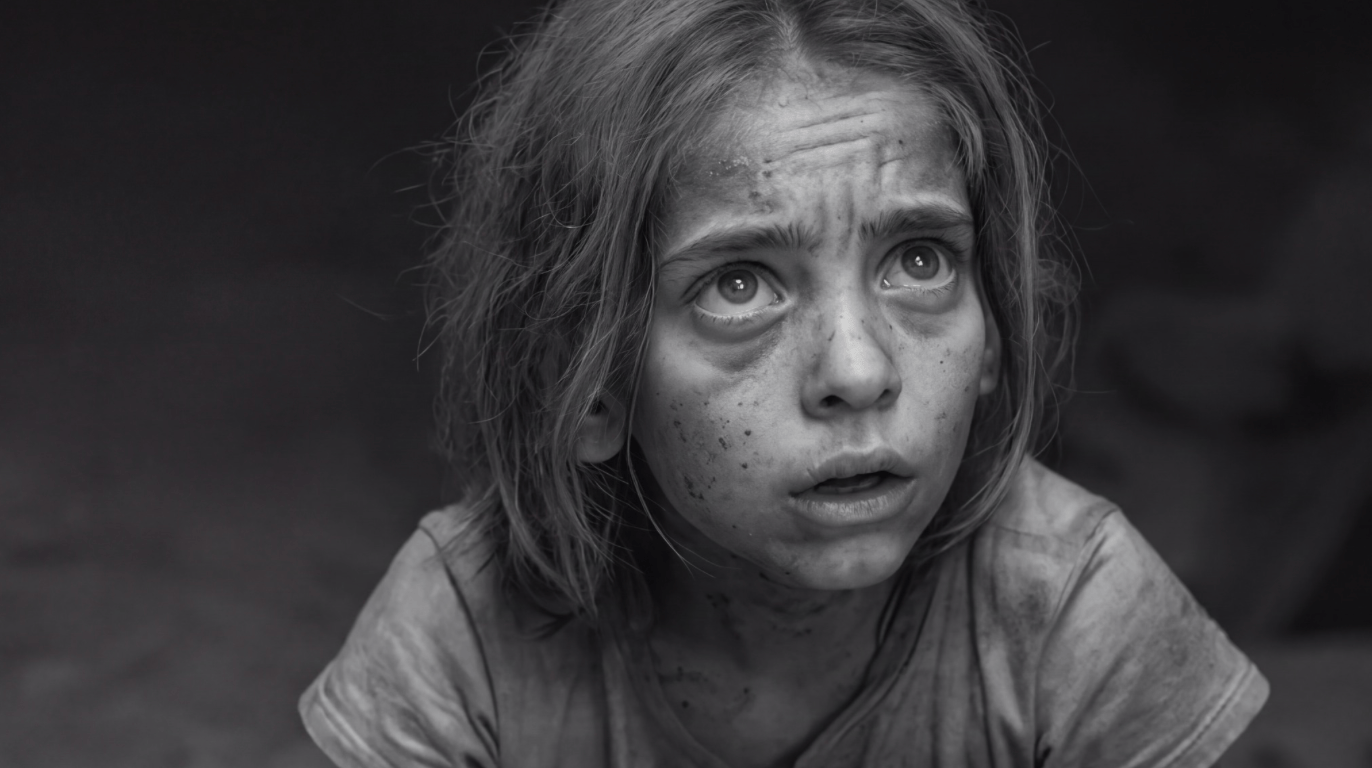
Drawing on 12 years working in some of the world’s most dangerous conflict zones, writer-director Ahmad Alameldeen delivers a powerful Oscar-qualified animated short exploring survival, humanity and the devastating consequences of using starvation as a weapon of war.
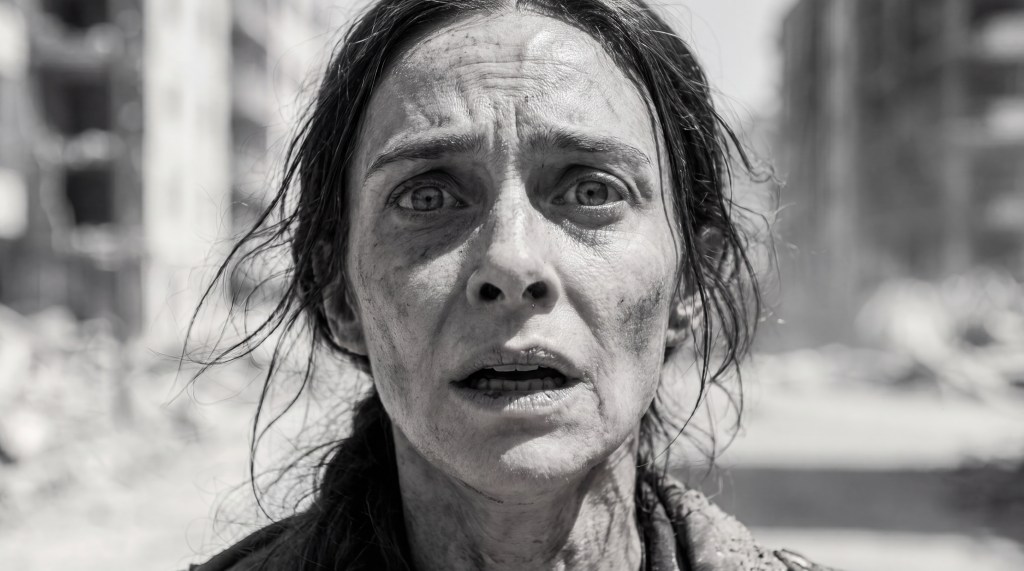
For 12 years, writer-director Ahmad Alameldeen witnessed the devastating realities of war firsthand. From Iraq and Syria to Somalia, Libya and Nigeria, he worked alongside some of the world’s leading humanitarian organisations, encountering families trapped by conflict, children facing starvation and communities desperately waiting for aid that might never arrive. Now, Alameldeen has transformed those experiences into SAFE ZONE, a haunting Oscar-qualified animated short confronting one of modern warfare’s most disturbing realities: the deliberate use of hunger as a weapon against innocent civilians.
Combining striking black-and-white imagery, original hand-drawn artwork and AI-assisted animation, SAFE ZONE follows a mother and daughter struggling to survive in a devastated city, where even reaching desperately needed food can mean risking their lives. Rather than identifying a particular country or conflict, Alameldeen has created a universal story about humanity, survival and the devastating consequences of war on those who never chose to fight.
For the filmmaker, the transition from humanitarian work to cinema was a continuation of a mission he felt remained unfinished. “Filmmaking is a continuation of the humanitarian aid work I used to do,” he explains. Having worked with organisations including the United Nations, the International Committee of the Red Cross and Médecins Sans Frontières, Alameldeen became increasingly frustrated by the limitations of humanitarian intervention. “The world sees the trucks and the tents and relaxes, and then the war continues. The aid keeps moving, but the suffering does not really stop.” That frustration inspired him to explore a different way of reaching people: cinema.
When Food Becomes a Weapon
Among the experiences that shaped SAFE ZONE, one memory from Mogadishu, Somalia, remains especially vivid. Alameldeen and his colleagues had organised a food distribution for families desperately in need, but when distribution day arrived, far fewer people appeared than expected. Many had been prevented from reaching the supplies. “Some families were trapped on the way, some were killed, and others were scattered and turned back. You stand there with the food ready, and the people it was meant for cannot reach you.”
For Alameldeen, the experience illustrated the cruelty of using starvation as a military tactic. “That is what hunger as a weapon really looks like. The aid is there, but the ones who need it most are kept away from it. And the ones who do reach it can pay for it with their lives.”
This devastating reality forms the emotional foundation of SAFE ZONE. At its centre is a mother desperate to protect her daughter, forced to navigate impossible choices in a world where survival depends as much on circumstance as courage. In one particularly affecting moment, the young girl finally reaches food but, rather than eating it herself, attempts to save it for her family and others sheltering alongside them. The moment was inspired by children Alameldeen encountered during his humanitarian career. “That came from real children who even while they were starving, thought first about their community, not themselves,” he explains. It is this attention to humanity that gives SAFE ZONE its emotional power, portraying not simply suffering, but compassion, dignity and extraordinary resilience.
A Universal Story Without Borders
Alameldeen deliberately chose not to identify any particular nation or contemporary conflict. Presented without dialogue and in stark black and white, SAFE ZONE allows audiences to recognise the human experience without immediately associating it with a particular side. “We didn’t name a country or a conflict, and made it in black and white aesthetics, and without dialogue. All of that was to make sure that no one watching could push it away as someone else’s problem.”
The response at international film festivals has reinforced his belief in that approach, with audiences from different backgrounds interpreting the film through their own histories and experiences. “A child hiding underground did not choose to be caught in the crossfire,” Alameldeen says. “Whatever side a person sits on, my hope is they can still watch this and agree on that issue, that hunger should never be used as a weapon or as bait against people who are not part of the conflict.”
At a time when images of war dominate international headlines, often reducing individual lives to statistics or political arguments, Alameldeen hopes SAFE ZONE encourages audiences to see the suffering of civilians as a shared human tragedy.
Where Human Artistry Meets Artificial Intelligence
Alongside its humanitarian subject matter, SAFE ZONE offers an intriguing example of how emerging technology can work alongside traditional artistic techniques. At a time when artificial intelligence remains contentious across the entertainment industry, Alameldeen and his team developed a hybrid animation process that placed human creativity firmly at its centre.
Initially, the filmmakers experimented with generating imagery entirely through AI, but discovered that the technology struggled to capture the emotional complexity and precise compositions required. Instead, every shot began as a hand-drawn graphite sketch before being developed digitally using Procreate. AI tools were then employed to enhance the imagery and animate compositions already designed by the filmmakers. The characters, storyboards, camera angles, editing, music and sound design remained under the creative team’s control.
“The AI tool did not invent anything on its own,” Alameldeen explains. “We chose this way because we wanted to keep control over every frame, so the tool served our work instead of leading it.”
The technology particularly struggled to portray children experiencing extreme distress, highlighting for the director the distinction between reproducing an image and understanding the emotion behind it. “An AI tool can copy a look, but it cannot understand what a frightened or starving child feels. That understanding must come from a person.”
An Extraordinary Journey to the Academy Awards
SAFE ZONE has qualified for consideration at the 99th Academy Awards, a significant milestone for Alameldeen, whose professional life was previously devoted to humanitarian aid rather than cinema. Leaving that career meant walking away from the only profession he had truly felt passionate about, with no guarantee that filmmaking would offer a viable alternative.
“Stepping toward filmmaking was not a safe move with something to fall back on,” he reflects. “I left the only field I had passion for, hoping to keep serving the same people in a different way through storytelling.”
The Academy qualification represents an encouraging step, but Alameldeen is particularly interested in the opportunity for his film to reach audiences beyond the festival circuit. “For a short film like Safe Zone, recognition means more people get to see it,” he says. His ambitions extend beyond awards recognition, however, with the director hoping viewers will connect with the characters rather than interpret the film solely through a political lens.
SAFE ZONE originally emerged from a live-action feature screenplay, with the animated short conceived as a proof of concept before developing into a standalone work. The proposed feature will expand the mother-daughter relationship while exploring the motivations of other characters, including the sniper who appears as a threatening presence in the short. Alameldeen has also developed three feature screenplays spanning the thriller, action and espionage genres, drawing on his experiences in some of the world’s most challenging environments.
A Film That Demands We See Humanity First
Perhaps the greatest strength of Ahmad Alameldeen’s SAFE ZONE is its ability to make an overwhelming global tragedy feel deeply personal. Through a mother, a daughter and a desperate struggle for survival, the director brings audiences face to face with the consequences of conflict without relying on political rhetoric or graphic spectacle.
Alameldeen believes that constant exposure to images of war risks making audiences increasingly desensitised to human suffering. “We reduce whole families to the side we think they belong to,” he observes. For the director, SAFE ZONE is an opportunity to challenge that instinct. “Safe Zone asks for just a few minutes of seeing a trapped family as people first, before any label is added to them.”
As SAFE ZONE enters the Academy Awards race, its significance lies not only in its distinctive animation or the remarkable personal journey of its director, but in the humanity at the heart of its storytelling. It reminds us that behind every conflict are ordinary families whose lives have been shattered by circumstances beyond their control.
For Ahmad Alameldeen, that recognition is ultimately more important than any accolade. “A story cannot end a war, but if it changes the way people view wars and conflict, that is already something.”
SAFE ZONE, written and directed by Ahmad Alameldeen, is qualified for consideration in the Best Animated Short Film category at the 99th Academy Awards.
Margaret Brown

