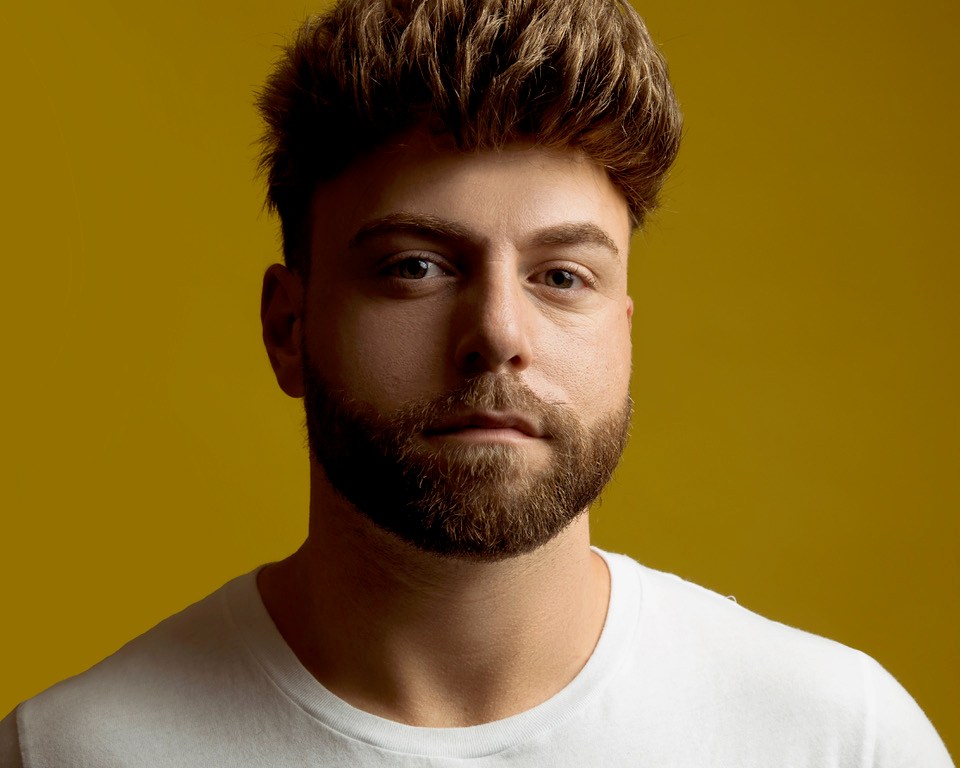
Narrated by Andy Serkis and created by 45 artists over the course of a year, Amos Sussigan’s Oscar-qualified animated short turns the story of an obsolete carrier pigeon into a timely reflection on technology, creativity and the future of artists.
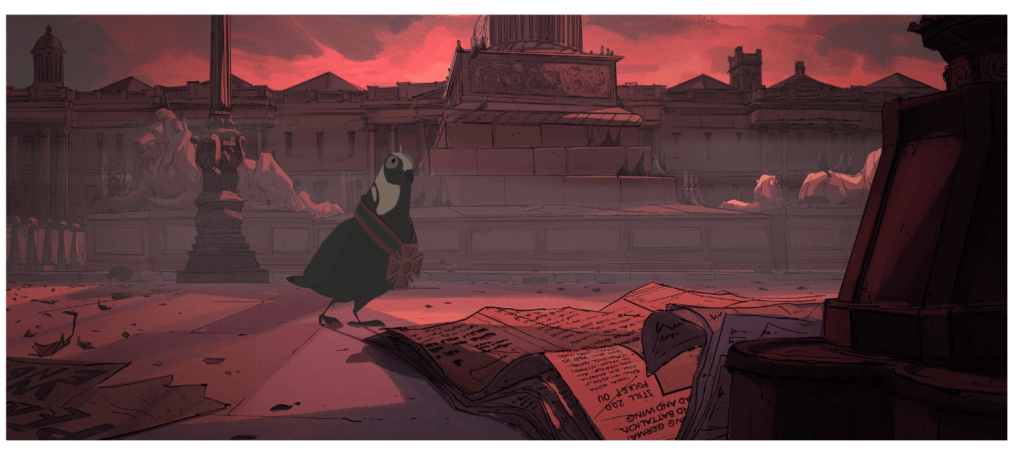
When filmmaker and Academy member Amos Sussigan first began thinking about PIGEONS, the idea came from an unlikely conversation about wartime carrier pigeons. A friend had shared an article about the vital role the birds once played, prompting a discussion about how instrumental pigeons had been throughout history. Then came a seemingly throwaway observation: “Just like us with AI.”
For Sussigan, who has worked across major animation productions for Warner Bros., Disney and Netflix, the comparison immediately struck a nerve. At the time, artificial intelligence was rapidly becoming one of the dominant conversations within the animation industry. Artists weren’t necessarily questioning whether their profession was going to change, but how quickly and how dramatically. “I could not stop thinking about it,” he says. “The idea was to make you think you are watching a short about pigeons, but the whole time it was a story about us.”
The result is PIGEONS, an Oscar-qualified animated short narrated by Andy Serkis that initially appears to tell the charmingly absurd story of a bird who loses his job, before revealing itself as something considerably more human. The film follows a carrier pigeon whose working life abruptly ends when a telephone is installed in his owner’s home. Suddenly no longer useful, he is forced out into the world in search of food, shelter and, ultimately, a new sense of purpose.
That idea was embedded in the film from the beginning, but as production progressed, the story became increasingly personal for Sussigan and the artists creating it. Many of the people working on PIGEONS were between jobs or found themselves in positions they weren’t particularly happy with, at a time when opportunities within animation were becoming more uncertain. Sussigan himself was working on a feature he loved, but could still feel the pressure of an industry undergoing significant change. What began as a story about progress gradually became a story about purpose.
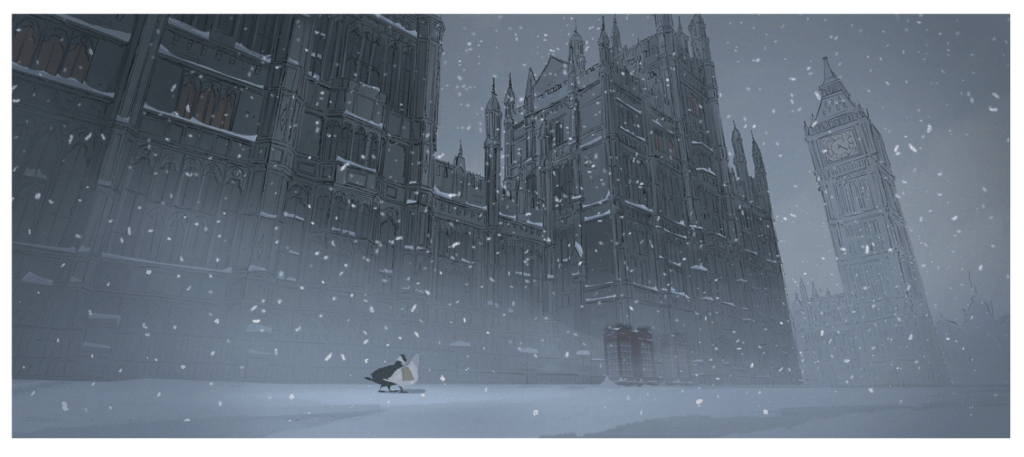
“Making the film gave us a little bit of that purpose ourselves,” he explains. “It became a love letter to animation, but also the simple joy of getting together with people you love and making something together that feels meaningful.”
Despite the obvious parallels with artificial intelligence, Sussigan is careful not to position PIGEONS as an anti-technology film. The telephone that replaces the carrier pigeon isn’t the villain. It is simply faster and more efficient technology doing exactly what technology has always done. The more uncomfortable question is what happens to those who are no longer considered useful once that progress arrives.
“The film is not anti-technology at all,” he says. “It is more an invitation to think about how we move forward without forgetting who or what came before us. The telephone is not the villain of PIGEONS. The problem is how quickly humans discard pigeons once something more efficient comes along. Progress itself isn’t bad, but progress without thought, empathy or responsibility can have a cost, and I think it’s the very question we find ourselves in right now.”
That philosophy also shaped how the film was produced. At a moment when technology can generate images in seconds, 45 artists from around the world spent a year creating PIGEONS by hand. The production had a budget of around $20,000, with the team largely making the film on weekends, relying on friends, collaborators and whatever resources they could find.
Rather than attempting to disguise those limitations, Sussigan made them part of the film’s visual identity. The team embraced simple animation, painted backgrounds and carefully selected movement, leaning into the individual strengths of its artists rather than trying to imitate the scale of a studio production. “We were always thinking about efficiency, but we never wanted efficiency to mean we were cutting corners creatively,” he says. “Every limitation became part of the look of the film.”
For Sussigan, what handmade animation offers in the age of AI comes down to care and intentionality. Traditional animation forces artists to make thousands of individual decisions, a line, a colour, a pose, what moves and what remains still, even something as seemingly insignificant as the colour of a background character’s shoelaces. All of those decisions eventually become part of the finished film.
“Personally, I think the difference is between finding an image you like and actually building an image around an idea,” he says. “It’s the imperfections, the choices, the things you choose to add or purposefully remove. Sometimes AI gives you lots of ‘free stuff’, but if you have a clear idea of where you are going, you might not need it, and it becomes a distraction.”
Bringing together 45 artists from different countries and generations presented its own challenge, but again the filmmakers used their restrictions creatively. Shawn Martins led the 3D animation, while veteran Disney artist and PIGEONS producer Dan Lund, who has worked at the studio since 1989, helped the team become highly selective about what actually needed to move. The filmmakers also borrowed techniques from older animated films. When they couldn’t afford to animate large crowds of pigeons, they painted them directly into the backgrounds. The decision saved time and money but also had an unexpected storytelling benefit: it made the principal characters appear even more isolated.
The wider creative team brought considerable industry experience to the independent production. Art Director Sergio Mancinelli worked on the Academy Award-winning The Boy, the Mole, the Fox and the Horse, while Sound Designer and Re-recording Mixer Peter Staubli of Formosa Group has credits including Skyfall. Senior Colorist Shane Harris of Company 3 worked on Rogue One: A Star Wars Story. Written by Julien M. Wagner, Timo von Gunten and Sussigan, PIGEONS is produced by Sussigan, von Gunten, Samira Sahli and Walt Disney Animation Studios’ Dan Lund, in collaboration with The Hub Media and BMC Films.
From the earliest draft, Sussigan and Wagner imagined PIGEONS almost as a traditional nature documentary. The narrator would describe what was happening with complete seriousness, without instructing audiences when to laugh or when to feel emotional. Sussigan was fascinated by the neutrality of nature documentaries, where something devastating can happen to an animal and the narrator simply observes it as part of nature. He wanted to approach technological progress in much the same way: the telephone isn’t evil; the pigeon simply isn’t needed anymore.
That concept made Andy Serkis an ideal narrator. Sussigan had previously worked with Serkis as Production Designer on Animal Farm and knew the actor could bring warmth to the story without making it sentimental. “You can trust his voice and he can make something as absurd as a pigeon losing his job funny and heartbreaking at the same time,” Sussigan says. “The comedy and emotion come from treating this little bird’s life with absolute seriousness.”
Writer Julien M. Wagner felt the same way. “Andy can make you laugh and break your heart in the same breath,” he says. “He makes something as absurd as a pigeon losing his job feel completely human, without ever forcing the emotion.”
Swiss-born Sussigan’s own career has moved between independent filmmaking and some of the world’s largest animation studios. He served as Production Designer on Serkis’ Animal Farm and Art Director on Warner Bros.’ The Cat in the Hat, while his next project is Warner Bros. Pictures Animation’s Hello Kitty. He has also worked across productions for Disney and Netflix and has been a member of the Academy of Motion Picture Arts and Sciences since 2020.
Yet Sussigan says one of the most valuable things he has gained from working within major studios is not a particular production technique, but the relationships he has formed. In many ways, PIGEONS became an opportunity to bring those relationships back together. Lund has been his mentor since he was at school, while Mancinelli has worked with him on almost every movie he has made over the past seven years. Other artists came to PIGEONS from projects at Paramount, Netflix and Disney.
On major studio productions, filmmakers don’t necessarily get to choose everyone they work alongside. The independence of PIGEONS gave Sussigan the opportunity to reunite artists he admired simply because they wanted to create something together. It also reinforced something increasingly important to him at a difficult moment for the animation industry: artists don’t necessarily need to wait for the industry to give them permission to create.
“We can work smaller, cheaper and differently,” he says. “If you really want to make something, you find a way.” The experience has worked in both directions, with Sussigan taking lessons learned on the $20,000 independent short back into his work on major studio productions.
That small weekend project has now travelled considerably further than its creators anticipated. PIGEONS won Best Production Design at Animayo 2026 and has screened internationally at Indy Shorts, HollyShorts, Flickers’ Rhode Island International Film Festival, Fantoche and Tirana International Film Festival, as well as screenings in Canada, New York, London and Los Angeles.
One of the biggest surprises for Sussigan has been how consistent the response has been across different countries and cultures. Audiences begin by laughing at the unfortunate pigeon before reaching the point where they recognise something of their own experience in his predicament. “People start by laughing at a pigeon and are caught off guard as soon as they realise they have been watching something much closer to themselves,” he says. “I think, in some way, we all recognise that feeling of wondering if the world is moving faster than we are.”
Now Oscar-qualified, PIGEONS finds itself entering the awards conversation at precisely the moment Hollywood is wrestling with fundamental questions about artificial intelligence, authorship and the future value of human creativity. For Sussigan, an Academy member himself, seeing such a small and deeply personal production reach this point is almost surreal.
“We made this movie for around $20,000. We made it on weekends, with friends, begging and borrowing whatever we could to get things on screen,” he says. “We made limitations our strength and we made a movie that says something about us, about where we are in the industry and how we feel as artists.”
Yet the Oscar conversation isn’t what Sussigan values most about the experience. Some of the younger artists who contributed to PIGEONS had never previously been part of a film travelling internationally on the festival circuit. They gave their time and talent generously, and now they are seeing their work projected on cinema screens, travelling with the film and watching audiences respond to something they helped create.
“That’s the part I am most grateful for,” Sussigan says. “Whatever happens next, we made something together that went much further than any of us expected.”
For a film born out of anxiety about technology, PIGEONS ultimately arrives somewhere unexpectedly optimistic. It doesn’t argue that progress should stop or that the past was inherently better. Instead, it asks how we can embrace progress without losing the people, skills, imperfections and human creativity that gave our work meaning in the first place.
At its heart, PIGEONS asks a deceptively simple question: when progress makes something obsolete, what happens to everything — and everyone — it leaves behind?

