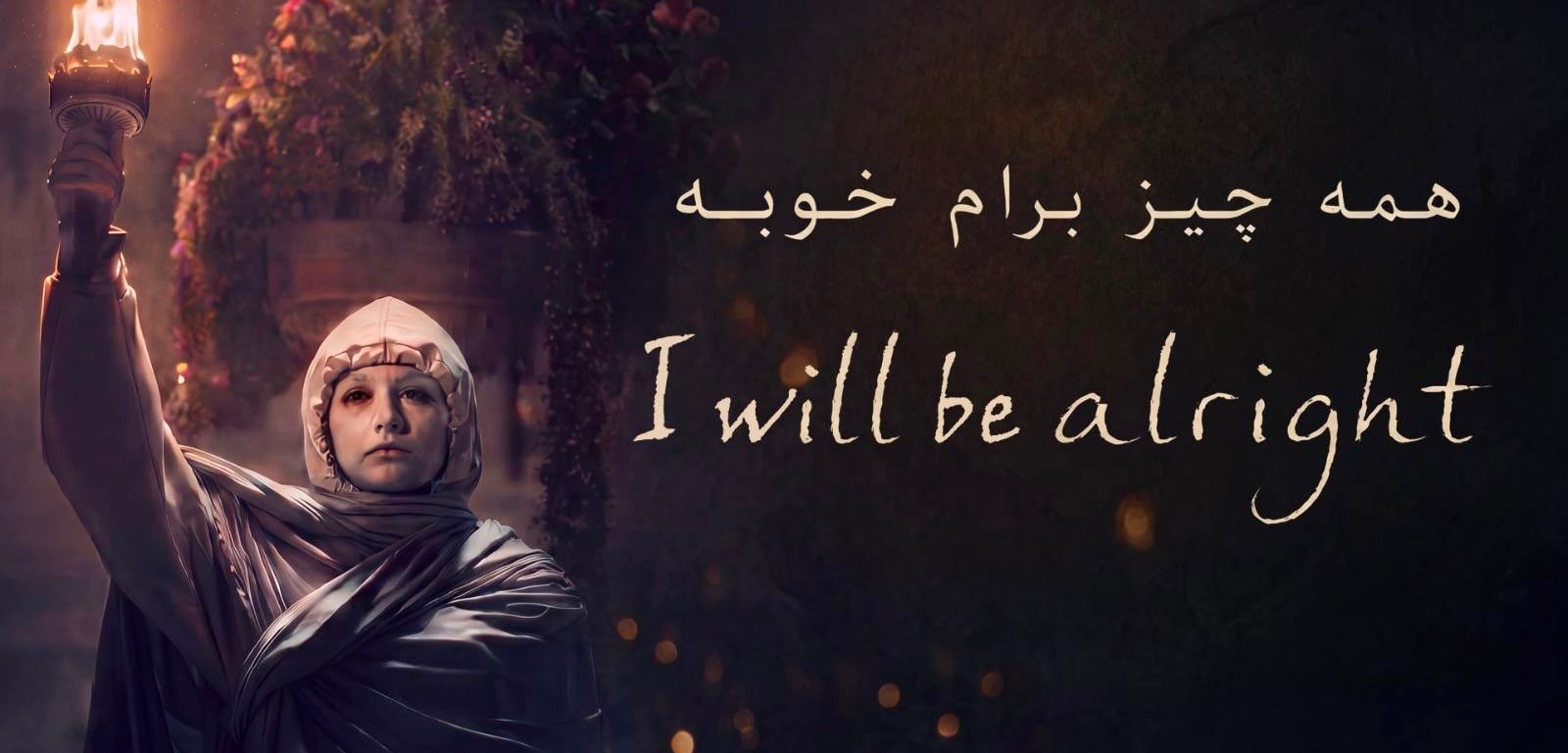
From The Red Suitcase to I Will Be Alright, the Oscar-nominated filmmaker continues to explore freedom, identity and the human connections that can transcend borders
Academy Award-nominated filmmaker Cyrus Neshvad returns to the Oscar conversation with I Will Be Alright, a deeply human drama about a 16-year-old Iranian refugee facing the possibility of deportation to the country she fled.
The film has qualified for consideration at the 99th Academy Awards after winning Best of Fest at the 30th LA Shorts International Film Festival, an Academy Award-qualifying prize.
For Neshvad, whose The Red Suitcase earned an Academy Award nomination for Best Live Action Short Film in 2023, the new film continues a body of work concerned with freedom, displacement and the often invisible barriers facing those attempting to build a life far from where they were born.
At the centre of I Will Be Alright is Laïla, a teenage Iranian refugee whose future hangs in the balance. While attempting to remain in the country she hoped would provide sanctuary, she earns money dressed as the Statue of Liberty. It is an immediately arresting image: a young woman whose own liberty is precarious forced to perform one of the world’s most recognisable symbols of freedom.
For Neshvad, however, the visual metaphor goes even further.
“First of all I wanted Laïla to be white. When she is covered in white, she attracts less attention, she is like the others.”
The idea, he explains, grew partly from his observations of how differently people can be treated because of the colour of their skin.
“It started with something very simple: skin color,” says Neshvad. “In many countries, when your skin is darker, you are more likely to attract the attention of the authorities, to be stopped, questioned, or asked for your papers. When you are white, you can often move through the same space without attracting that attention.”
That notion is built directly into Laïla’s transformation into the Statue of Liberty. When standing motionless, Neshvad wanted her body to suggest submission, even condemnation. But when somebody gives her a coin, her torch illuminates, her posture changes and, momentarily, so does her relationship with the world around her.
“The flame lights up, her head rises, her body straightens, and she lifts her arm like the Statue of Liberty,” he explains. “For me, that flame represents freedom. For a brief moment, she is no longer submitting, she is free.”
It is a potent piece of visual storytelling, but one rooted in Neshvad’s own experience.
Of Iranian origin, the filmmaker moved to Luxembourg at the age of five. Growing up between cultures gave him an early awareness of what it meant to be perceived as different.
“I grew up with this feeling of being different,” he says. “The language, of course, but especially the color of my skin. As a child, you feel that difference through the eyes of others. As you grow older, you begin to feel it through the eyes of the authorities, being asked more often to show your identity papers, for example.”
He also speaks about the complicated burden that can accompany nationality.
“When the country you come from has a complicated relationship with the rest of the world, you sometimes end up carrying the consequences of decisions you had nothing to do with.”
Yet I Will Be Alright is not solely about immigration or deportation. Beneath its wider political context, Neshvad sees the film fundamentally as a story about family and human connection.
On one side is Laïla and her mother, with a parent prepared to make an extraordinary sacrifice in the hope that her daughter might remain free. On the other is a Luxembourgish father struggling to reconnect with his daughter, a teenager who has lost her desire to live.
“I wanted to bring these two very different families together through the two teenage girls,” Neshvad explains. “One is fighting for the right to live freely, while the other no longer wants to live.”
It is through their meeting that the film’s central idea emerges.
Neshvad has described I Will Be Alright as an exploration of how “our survival depends on human unity.” For him, that unity is not one-directional. Laïla needs the Luxembourgish girl, but the Luxembourgish girl also needs Laïla.
“Laïla finds a path to freedom through the Luxembourgish girl. But it also works the other way around,” he says. “Through her relationship with Laïla, the Luxembourgish girl finds her own kind of freedom by reconnecting with her father.”
He adds: “We need each other to grow. I like to think that we are all beautiful and different flowers growing in the same garden. Our differences don’t make us weaker, they are what make us stronger.”
Life after an Oscar nomination
Neshvad has been here before. The Red Suitcase, another story centred on a 16-year-old Iranian girl, received an Academy Award nomination for Best Live Action Short Film at the 95th Oscars.
The recognition inevitably changed the trajectory of his career, but Neshvad describes its effect on him in surprisingly simple terms.
“It gave me more confidence and taught me to believe more in myself.”
With that recognition also comes expectation. Returning with another short after an Oscar nomination could easily create pressure to reproduce that success, something Neshvad acknowledges.
“Yes, maybe,” he says when asked whether The Red Suitcase created additional pressure. “But what matters most to me is the visibility of the film, because through it, I want to contribute, even in a small way, to building a world where our sense of human unity can grow stronger.”
That answer says much about his approach. Awards can give a film a larger platform, but for Neshvad the platform matters because of what can be communicated through it.
Two films, one awards season
This awards season is particularly significant for the filmmaker because I Will Be Alright is not his only film entering the Academy conversation.
His feature directorial debut, Child, has been officially selected by Luxembourg to represent the country in the Best International Feature Film category at the 99th Academy Awards. The psychological drama/horror feature had its world premiere at the 2026 Raindance Film Festival.
It places Neshvad in the unusual position of navigating the season with an Oscar-qualified short alongside a debut feature selected as his country’s official international submission.
Yet he does not draw a significant creative distinction between the two formats.
“I don’t see any difference between doing a feature film and a short film,” he says. “It needs the same dedication and love.”
That philosophy extends to the business and cultural value of short filmmaking. For a filmmaker whose career has been substantially built through shorts, the format is not simply a training ground before features.
“I think that as long as we tell a story with heart and dedication, it will always have value, whether it is long or short.”
Freedom as something shared
What makes I Will Be Alright particularly interesting within Neshvad’s filmography is the way its central metaphor works on several levels at once.
Laïla is attempting to escape one system while discovering that safety elsewhere is not necessarily guaranteed. She physically disguises herself as an icon of liberty while her own ability to remain free is being determined by forces outside her control. Yet Neshvad resists reducing the story to institutions and borders alone.
His attention repeatedly returns to people.
The film proposes that freedom can also exist in small acts of recognition: one person seeing another, one family intersecting with another, two teenage girls discovering that despite radically different circumstances, each has something the other needs.
It is an intimate approach to an enormous subject, and one that connects I Will Be Alright to the themes that have run through Neshvad’s work, particularly The Red Suitcase. Both place a young Iranian woman at the centre of a situation in which decisions about her freedom threaten to be made by others. Yet the new film expands that conversation into one about mutual dependence and solidarity.
After an Oscar nomination, hundreds of festival screenings across his body of work, a move into feature filmmaking and now another Oscar-qualified short, Neshvad could reasonably be focused on what comes next for his career.
Instead, when asked what he hopes Academy voters and audiences ultimately take from Laïla’s story, his answer is characteristically brief.
“The feeling of love to be all together.”
For Cyrus Neshvad, that may ultimately be the idea at the heart of I Will Be Alright: freedom is not simply about where we are permitted to live, but about whether we are willing to recognise one another once we get there.
Margaret Brown

