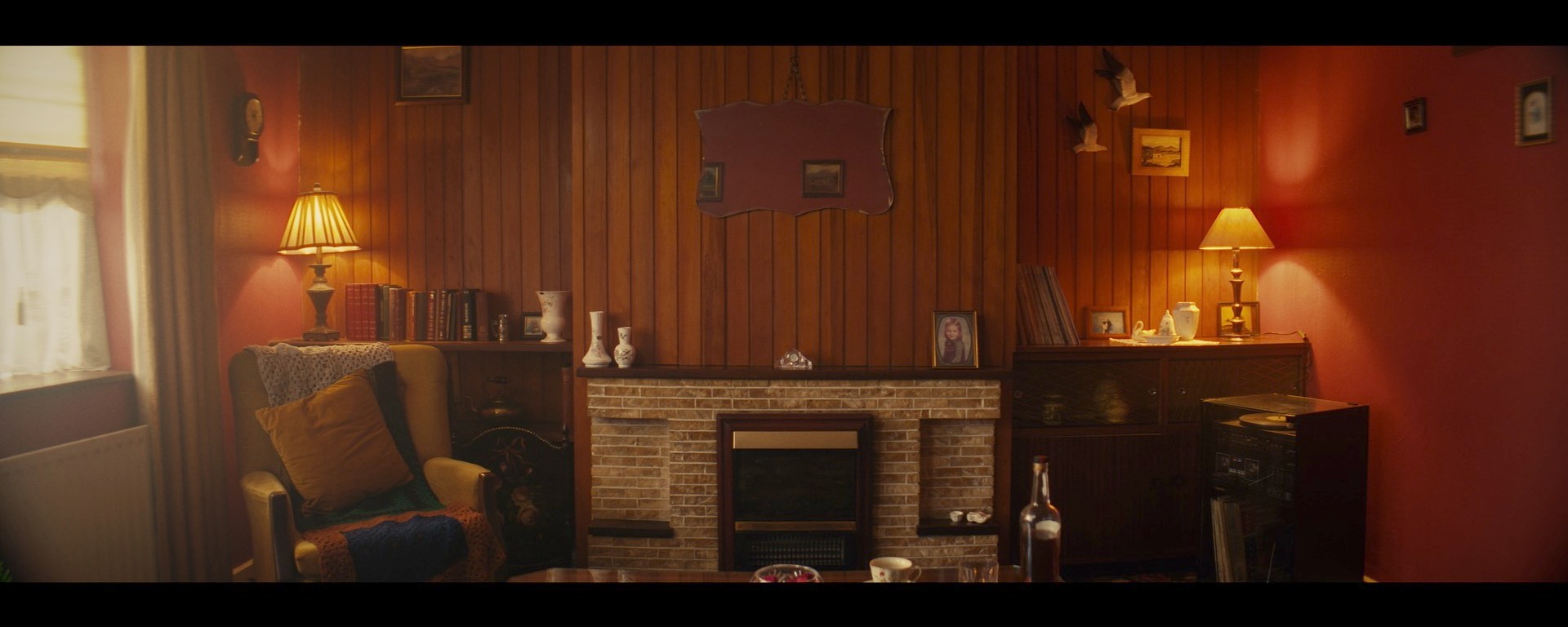
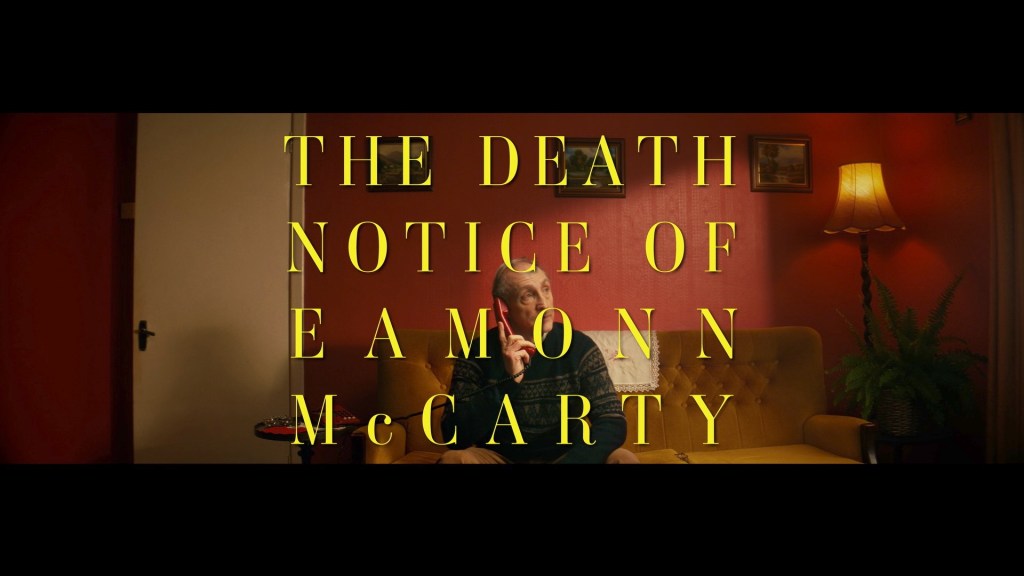
The writer-director of The Death Notice of Eamonn McCarty talks Michael McElhatton, finding humour in mortality, learning from the Oscar-winning filmmakers behind An Irish Goodbye, and why qualifying for the 99th Academy Awards still feels like a dream.
For Irish filmmaker Aaron Chalke, an idea rooted in one of the most familiar traditions of his childhood has taken him somewhere he never quite imagined: into the race for the 99th Academy Awards.
His directorial debut, The Death Notice of Eamonn McCarty, is now Oscar-qualified for Best Live Action Short Filmfollowing its Best Irish Short win at the Foyle Film Festival.
“It feels surreal and very exciting,” Chalke says. “It’s a real honour to be included at this stage of the Oscar race — a real dream come true.”
Starring Michael McElhatton, known internationally for Game of Thrones and Chernobyl, alongside Irish actor and comedian Hannah Mamalis, the darkly comic short begins with an extraordinary proposition: what if you received your own death notice before you died?
For Chalke, however, the origins of that premise are grounded in something very real.
Growing up in County Mayo, death notices were simply part of everyday life. Local radio stations would interrupt their regular programming several times a day to announce recent deaths and provide details of wakes and funeral arrangements.
“Death notices were a feature of daily life,” Chalke explains. “Multiple times a day, five minutes of airtime would be dedicated to reading out the death announcements and funeral arrangements for the recently deceased.
“While it may seem odd, it was part of daily life, and it helped me with the premise of the film: what if death notices were used in advance of someone’s passing, rather than after?”
The resulting film follows Eamonn, a man who discovers that he apparently has only 24 hours left to live. Faced with the biggest existential crisis imaginable, he does what so many of us are forced to do in moments of considerably less urgency: he gets stuck dealing with customer service.
It is an absurd collision between mortality and bureaucracy, but that contrast is central to Chalke’s comedy.
“The idea of getting an advance death notice is quite out there, but I wanted it to feel grounded, as if it were part of normal everyday life,” he says. “And what could be more normal than having to deal with customer service phone lines and bureaucracy?
“I loved the irony that created. It helped establish the dark comedy while allowing us to explore the bigger premise.”
Beneath the humour is something deeply personal.
The loss of Chalke’s mother influenced the story and sharpened his awareness of how quickly the ordinary can become precious.
“It helped put into perspective that every moment is precious and special, and that you don’t know what’s around the corner,” he says. “So live the life you want without waiting.”
That thought runs through The Death Notice of Eamonn McCarty. If Eamonn’s predicament feels fantastical, the question it raises could hardly be more universal: if we knew precisely how much time we had left, would we continue living the way we do now?
“The main takeaway is that life is short, and nobody knows how short,” Chalke says. “So make the most of it from right now. Don’t delay that dream, that conversation or that desire you’ve always had. Enjoy the now.”
FINDING COMEDY IN THE DARKEST PLACES
The combination of grief, death and humour places the film within a rich tradition of Irish storytelling, where comedy and tragedy frequently sit side by side.
It is something that has travelled successfully to international audiences in recent years, perhaps most famously through Ross White and Tom Berkeley’s Academy Award-winning short An Irish Goodbye.
For Chalke, dark comedy offers a particularly Irish route into subjects that might otherwise feel too painful or uncomfortable to approach directly.
“I think it’s our way of dealing with heavy topics,” he explains. “In Ireland, we like to talk around issues, using humour and chat to avoid the deeper subjects.
“Dark comedy gives us a way to explore existential storytelling while still keeping it at arm’s length, where it feels most comfortable.”
Chalke has since been mentored by White and Berkeley, whose own journey with An Irish Goodbye culminated in the Academy Award for Best Live Action Short Film.
“These two are amazing people,” Chalke says. “I fell in love with An Irish Goodbye the first time I saw it on the film festival circuit.
“Their advice has been invaluable in helping me become more comfortable ahead of shooting — examining different ways of telling a story visually and making sure those choices are locked in for a reason.”
MICHAEL McELHATTON BRINGS EAMONN TO LIFE
Central to Chalke’s film is Michael McElhatton, whose extensive screen career includes Game of Thrones, Chernobyl and House of Guinness.
Getting an actor of McElhatton’s calibre for a first narrative short might appear daunting, but the actor responded to the script and joined the production at exactly the right moment.
“I was very lucky that Michael came on board,” says Chalke. “He loved the script and had just wrapped House of Guinness Series One, so the timing was perfect.
“He brought so much to Eamonn. He helped me fine-tune who the character was, his feelings and his attitudes. Before Michael came on board, Eamonn was just words on a page. Michael made him a living, breathing entity.”
Opposite him is Hannah Mamalis as Geraldine — a part Chalke had envisioned for the actress from the very beginning.
“I wrote Geraldine with Hannah in mind from day one — I’m just glad she said yes,” he laughs.
“She was perfect for the role. Her acting ability, razor-sharp comedy instincts and openness as a collaborator were the ideal combination.
“She and Michael worked brilliantly together, especially when we tried some small improvisations in certain scenes. Watching two comedy greats sparking off each other was joyous.”
FROM ADVERTISING TO NARRATIVE FILM
Before stepping behind the camera as a narrative director, Chalke spent more than 16 years working across advertising and commercials.
Far from being a separate chapter of his career, that experience helped shape the discipline required for short-form storytelling.
“It helped enormously when editing both the script and the film,” he says. “I was comfortable trying to tell the story in as short a space of time as possible, paring it down to the essentials while protecting the emotional impact.
“That was key — keeping it brief but impactful.”
For Chalke, brevity is not simply a practical necessity of the format. It is part of what makes a great short film so satisfying.
“A great short film is one of the most delicious things you can watch,” he says. “For me, a great one grabs you with humour, is authentic to the filmmaker’s style and treats the audience with respect.
“And it has to be short! Arrive late and leave early.”
The approach appears to have connected.
Alongside its Foyle success, The Death Notice of Eamonn McCarty has travelled internationally through festivals including Rhode Island, Indy Shorts and Newport Beach, introducing audiences far beyond Ireland to the very specific cultural tradition at the centre of the film.
That international response surprised its director.
“It’s been a lovely surprise, particularly because the death notice element plays on a very niche cultural tradition,” Chalke says. “I think the emotional journey and comedy help the piece travel. Ultimately, its theme is something anyone can relate to.”
THE OSCAR DREAM
Now that journey has reached awards season.
For a filmmaker whose first narrative short has already taken him into Academy Award contention, the possibility of an Oscar nomination remains difficult to comprehend.
“A nomination would be a long-held dream come true,” Chalke says. “It still feels so far away and distant, but seeing other Irish filmmakers carve a path makes it one I hope to follow.
“It would show that Irish successes aren’t flukes — that we can consistently make films at this level.”
Whatever happens in the Oscar race, Chalke is already moving forward.
His second film as director, The Dead House, written by Martin Beanz Warde, will premiere at the Cork International Film Festival on November 13 after Chalke won the Ardán/RTÉ Short Film Commission.
Once again, dark humour and emotionally difficult conversations sit at the heart of the story.
“I love this film because it was written honestly, from the heart, and has the right balance of emotional storytelling and dark humour — my favourite combination,” Chalke says.
Adapted from a play of the same name, The Dead House centres on a conversation delayed for 40 years between a gay Traveller and his father, unfolding during his grandfather’s wake.
It suggests that Chalke has found his territory as a filmmaker: stories that stare directly at uncomfortable truths while still finding space for humour, warmth and humanity.
And perhaps The Death Notice of Eamonn McCarty has changed its filmmaker as much as its central character.
Asked how he would spend his own final 24 hours if he were handed Eamonn’s news, Chalke does not hesitate.
“I’d have one last conversation with those I love and spend as much time as possible with my wife, drinking great Irish whiskey, eating the best Neapolitan pizza I could find and listening to The Gloaming.”
More importantly, the film has made him less inclined to wait for permission to pursue the things that matter to him.
“It has encouraged me to write and explore creatively through film and other formats, to create for the joy of creating and to follow mad dreams,” he says.
“Like chasing an Oscar nomination.”

