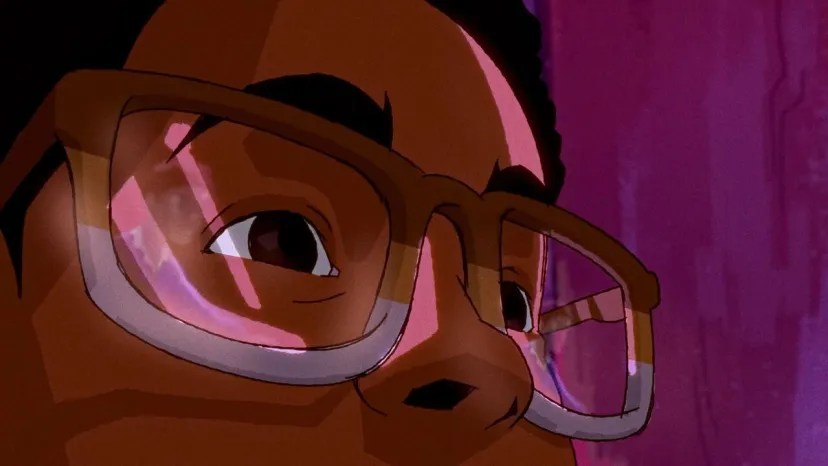
Directed by South African artist Pola Maneli, with music supervision by Grammy winner Black Coffee, the animated short draws on the real childhood friendship of writers Tim Jones and Lubabalo Mtati, two boys whose bond crossed the racial divisions of apartheid.
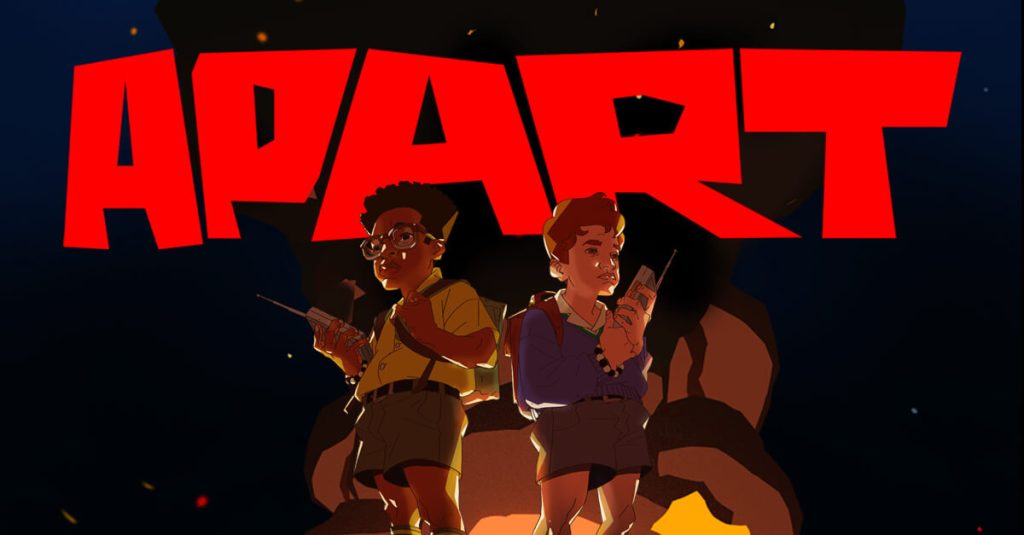
At the heart of APART is a deceptively simple idea: children are not born knowing who they are supposed to fear.
Set against the brutal racial divisions of apartheid-era South Africa, the 17-minute animated short follows Themba and Joel, two boys whose friendship develops through a shared love of football in a society constructed to keep them apart. What begins as childhood companionship ultimately becomes a story of courage, sacrifice and an extraordinary life-saving gesture.
But behind the animation lies something deeply personal.
APART is inspired by the real childhood friendship between two of its writers, Tim Jones and Lubabalo Mtati, who grew up in South Africa during apartheid and discovered one another before fully understanding the forces that were supposed to divide them.
“Our friendship began the way childhood friendships do: we just found each other,” Jones recalls. “No prejudice. No learnt biases. Just pure curiosity, joy, and a shared love for life.”
Only as the boys became older did they begin to understand the significance of the world surrounding them.
Jones remembers knowing there were rules governing where people could live, attend school and move through society, without initially grasping their full meaning. Looking back, he came to understand both how unusual the friendship was and, as he describes it, “how much courage it quietly took.”
For Mtati, born in 1987 and raised first in New Brighton in Port Elizabeth before moving to Bluewater Bay, apartheid was initially something experienced rather than intellectually understood. Moving from a community where almost everyone looked like him to a neighbourhood where almost nobody did exposed him to different manifestations of the same system.
It was only later, he says, that he understood how much of our worldview can be inherited before we are old enough to question it — including ideas about identity, belonging and the people we consider different from ourselves.
That idea forms the emotional centre of APART.
Written by Spike Lee, Tim Jones, Jeff Leisawitz and Lubabalo Mtati and directed by internationally acclaimed South African artist Pola Maneli, the film asks what happens when the instinctive connection between two children collides with a society teaching them that they should be separated.
For Mtati, the story is ultimately about recognising another person’s humanity regardless of what the outside world tells us to believe.
“I love the thought that something as simple as friendship can challenge those ideas,” he says. “That two people choosing to care about each other can become an act of courage.”
A CHILD’S VIEW OF APARTHEID
Rather than approaching apartheid solely as history or politics, APART experiences it primarily through the eyes of children.
That distinction gives the film much of its emotional force.
Children, Mtati explains, tend to judge one another through immediate human experiences: who is kind, who makes them laugh, who they enjoy being around. Placing that innocence beside the cruelty and complexity of apartheid creates a stark contrast.
“If two children can recognise the humanity in each other, why is it so difficult for the rest of us?” he asks.
Football becomes one of the bridges between those worlds.
For the real-life friends, the game created a place where inherited divisions could temporarily disappear. Jones describes football as a sport that demonstrates the necessity of working together and recalls how it allowed the pair to “escape into our own little world.”
In APART, that shared passion becomes the foundation of Themba and Joel’s friendship and a symbol of the equality that the society surrounding them refuses to recognise.
600 DAYS. 266 ARTISTS. 18,000 FRAMES. NO AI.
The film’s story of human connection is mirrored by the way it was created.
Over 600 days, 266 artists created approximately 18,000 frames, with the production combining traditional 2D frame-to-frame animation, cut-out techniques, 3D and 2.5D animation.
No AI was used in the creation of the film.
At a moment when the role of artificial intelligence in animation and filmmaking is being intensely debated, APARTinstead stands as a celebration of human artistry and collaboration.
Its visual identity draws heavily from director Pola Maneli’s distinctive artistic language, incorporating woodcut-inspired imagery that pays tribute to art forms historically used to communicate anti-apartheid messages, bypass censorship and document the experiences of Black South Africans.
Maneli’s work has appeared on the cover of The New Yorker and is held in the collection of the Smithsonian National Museum of African American History and Culture.
Animation also allowed the filmmakers to find a visual language capable of holding both the innocence of childhood and the violence of the world surrounding the characters.
“You’re watching something that isn’t technically real, yet the emotions are incredibly real,” Mtati says. “Animation allows us to preserve that sense of wonder and innocence while still confronting the reality of the world around them. It creates space for both beauty and heartbreak to exist together.”
A DISTINCTLY SOUTH AFRICAN FILM
The creative team assembled around APART gives the film an unmistakably South African identity while bringing together internationally recognised talent.
Grammy-winning South African musician Black Coffee serves as music supervisor, while acclaimed South African fashion designer Laduma Ngxokolo created the characters’ distinctive isiXhosa-inspired wardrobe.
For Mtati, maintaining that cultural specificity was essential.
“The most important thing is that APART remains rooted in its South African identity,” he says, while noting that the honesty of that specificity is precisely what allows the film to connect universally.
Produced by Social Popcorn Films and 40 Acres and a Mule, in association with Taking Over NY, APART premiered at the 2026 Tribeca Festival and has also been selected for the Provincetown Film Festival, SIGGRAPH and deadCenter Film Festival.
A STORY FROM THE PAST WITH A MESSAGE FOR THE PRESENT
Although apartheid formally ended more than three decades ago, APART deliberately looks beyond history.
The structures may change, but the instinct to divide people into opposing groups remains painfully familiar.
Jones sees direct parallels between the world in which he and Mtati grew up and contemporary political and social tensions.
“Division still finds new ways to show up,” he says. “But the same truth applies now as it did then: connection starts small, with two people choosing to see each other.”
Mtati similarly acknowledges South Africa’s enormous progress while resisting the idea that the consequences of apartheid simply disappeared with changes in law.
Inequality, opportunity and inherited attitudes can survive long after legislation changes, he argues, making reconciliation something that requires the work of successive generations.
That is what ultimately makes APART more than a story about apartheid.
It is a film about the things human beings inherit — prejudice, fear, social divisions — and whether we choose to perpetuate them.
It is also about the possibility that friendship, kindness and empathy may be more powerful than they first appear.
For younger audiences who never experienced apartheid, Mtati hopes the film carries one message above all: the world we inherit does not have to be the world we accept.
“Kindness, empathy and friendship aren’t small things,” he says. “They can be incredibly powerful choices.”
And perhaps that is the essence of APART’s awards-season appeal.
Behind its intricate animation, acclaimed collaborators and ambitious visual design is something elemental: two children looking at one another before the world has completely taught them how to look away.
As Mtati puts it, beneath the identities and beliefs society gives us, human beings are fundamentally searching for many of the same things — “to be loved, to be understood, and to belong.”
In APART, friendship becomes an act of resistance.
And in a world still discovering new ways to pull people apart, that message feels anything but historical.

