★★★★★
There are films that announce their importance loudly, and there are films that trust the audience enough to let their meaning slowly take hold. Alex Lanipekun’s ECHOES belongs firmly to the latter.
Oscar-qualified and featuring an exceptional British ensemble led by Ashley Walters and Leo Gregory, ECHOES is a beautifully controlled, deeply affecting examination of childhood trauma, male friendship and the damage that can remain hidden long after the events themselves have been buried.
Written, directed and produced by Lanipekun, the London-set drama centres on Andre (Walters) and Robert (Gregory), two men unexpectedly brought together by a shared boarding-school past. What initially appears to be a story about two very different adult lives gradually reveals something much darker, an experience that neither man has truly escaped.
Lanipekun handles that revelation with remarkable restraint.
Rather than using trauma as a dramatic device, ECHOES is interested in its aftermath, the way an experience can become embedded in a person, shaping relationships, behaviour, anger, silence and self-perception decades later. It asks what happens to boys who learn that vulnerability is dangerous and then grow into men who have never been given the language to articulate what happened to them.
The result is a film that feels both intensely personal and painfully universal.
Ashley Walters is outstanding as Andre. There is a tremendous amount happening beneath the surface of his performance, and Walters understands that the most devastating moments do not necessarily require the biggest gestures. He gives Andre a guardedness that feels completely lived-in, you sense a man who has spent years constructing the emotional armour necessary to keep moving forward.
It is an extraordinarily measured performance, and one that demonstrates again why Walters has become one of Britain’s most compelling screen actors.
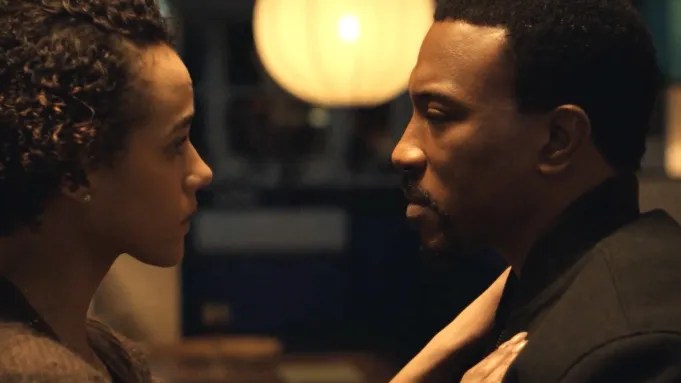
Leo Gregory is equally impressive as Robert, bringing a different energy to the same buried history. The chemistry between Walters and Gregory is crucial because ECHOES ultimately depends upon our belief that these two men recognise something in one another that the rest of the world cannot see.
Their scenes together carry an extraordinary tension. Words matter, but so do pauses, glances and everything neither character initially knows how to say.
Emmett J. Scanlan, as Mr. Dolor, makes a considerable impact, while Nathalie Emmanuel brings further emotional texture to an already formidable ensemble. There isn’t a weak performance here. More importantly, nobody appears to be competing for attention. Every actor serves the story.
That discipline extends to Lanipekun’s direction.
There is a confidence to ECHOES that is particularly striking. Lanipekun resists over-explaining his characters and never seems frightened of silence. He allows uncomfortable moments to remain uncomfortable and trusts his actors, and his audience, to inhabit them.
It is precisely that restraint that makes the film hit as hard as it does.
The original score from Grammy Award-winning producer and songwriter Al Shux complements rather than dictates the emotion, while the wider production has a polished cinematic quality that belies the limitations traditionally associated with the short-film form.
But the technical accomplishment of ECHOES would mean little without the humanity at its centre.
This is ultimately a story about what men carry.
It examines the consequences of a culture in which boys are so often taught to suppress fear, vulnerability and pain, particularly when those feelings are attached to experiences surrounded by shame. ECHOES understands that silence can become a survival mechanism, but also that survival and healing are not necessarily the same thing.
There is courage, too, in the film’s refusal to provide easy answers. Confronting the past cannot undo it. Speaking about trauma does not magically erase its consequences. What it can potentially do is break the isolation surrounding it.
That distinction gives ECHOES its emotional maturity.
It also makes the involvement of mental health charity Mind UK feel particularly appropriate. The film never resembles an issue-led campaign disguised as drama, its themes emerge naturally through character and story. That is exactly why its message resonates.
Behind the film is an unusually impressive producing team. ECHOES is produced by three-time Emmy Award nominee Nathalie Emmanuel, Tommy Popps, O. Valerie Nicholas and BAFTA-nominated producer Stephanie Charmail, with executive producers including Nicholas Pinnock, 2026 Academy Award nominees Lee Knight and James Dean, Francesca Dutton and Oliver Trevena.
The film also represents an important step for Rebel Island, the production company co-founded by Lanipekun and Emmanuel. If ECHOES is an indication of the kind of work the company intends to champion, its future will be worth watching closely.
Already, the film has attracted considerable recognition. Selected from more than 8,000 submissions to HollyShorts, it received a nomination for an Oscar-qualifying award at the festival and has subsequently secured its Oscar qualification as it moves into the 2026–27 awards season.
That recognition is understandable.
Short films have very little time in which to establish characters, create a world and leave an emotional imprint. The finest examples don’t feel like compressed feature films, they understand that brevity can itself become part of the storytelling.
ECHOES understands that beautifully.
Lanipekun has created a film that is economical without feeling slight, emotionally powerful without becoming manipulative and socially relevant without allowing its message to overwhelm its characters.
Most impressive of all is what remains after the credits.
The title ECHOES proves particularly apt. This is a film about the things that reverberate, memories, words, experiences and wounds that may become quieter with time but do not necessarily disappear.
Ashley Walters and Leo Gregory deliver superb, deeply human performances, while Lanipekun directs with sensitivity, confidence and admirable restraint.
ECHOES doesn’t shout to be heard.
It doesn’t need to.
Margaret Brown

