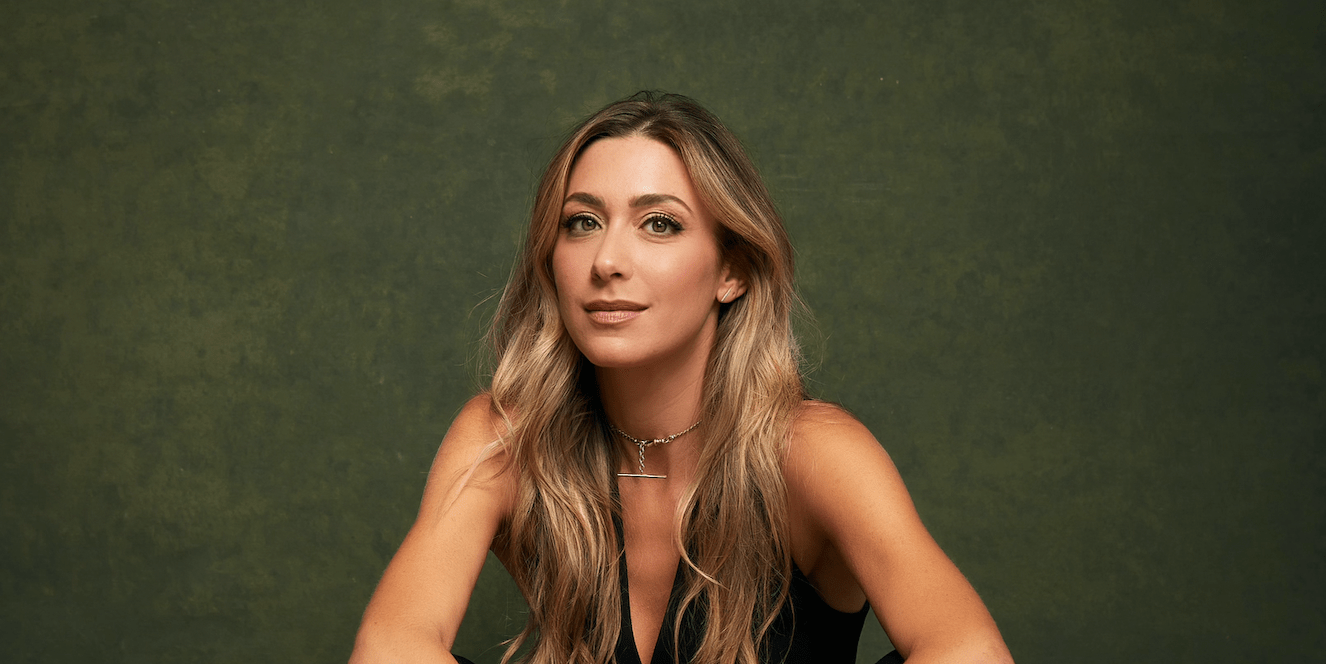
Meet Lara Everly, The Director Turning Personal Trauma Into Fearless Cinema
At the 2026 Tribeca Festival, filmmaker Lara Everly arrives with a distinction few directors achieve in a single year: two short film premieres. But for Everly, the milestone is less about industry validation than survival, reinvention, and artistic catharsis.
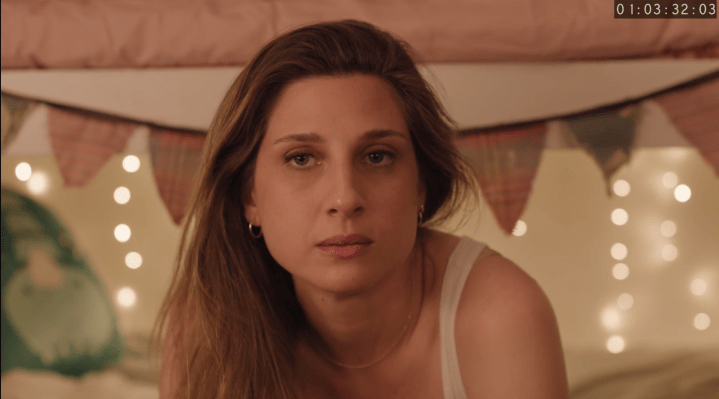
RECONSTRUCTING CHARLIE
Her two Tribeca selections, RECONSTRUCTING CHARLIE and SELAH, are vastly different in tone and setting, yet spiritually connected through their focus on women navigating autonomy, identity, survival, and impossible choices. One emerged directly from Everly’s own breast cancer journey. The other unfolds as a politically charged road movie about bodily autonomy and freedom. Together, the films establish Everly as one of Tribeca’s most emotionally fearless and stylistically distinct emerging voices.
“I’m grateful,” Everly says. “This time last year I was in the middle of a divorce and breast cancer treatment, so a year later to fully be on the other side with a completed film based off my experience, Reconstructing Charlie, is definitely therapy.”
The emotional weight behind that statement extends into both films, but so does something equally central to Everly’s voice: humor.
“Humor is my love language and survival skill,” she says. “It’s how I catabolize the hard in my life and that directly translates to my filmmaking.”
That dark, biting sensibility runs through her work, allowing devastating emotional material to coexist with absurdity, rage, sexuality, and uncomfortable laughter.
Turning Personal Trauma Into Defiant Storytelling
Produced through the inaugural Vital Stories Filmmaker Program from Tribeca Studios and Eli Lilly, RECONSTRUCTING CHARLIE grew directly out of Everly’s experience with breast cancer treatment and recovery.
The project began after Everly attended an Emmy event hosted by The Female Quotient featuring Bryce Norbitz from Tribeca Inclusion, Lina Polimeni from Eli Lilly, and comedian Tig Notaro discussing the launch of Vital Stories and its mission to create more authentic portrayals of disease in entertainment.
“I was a couple months post-radiation and was like, welp, I’m literally living this right now,” Everly says.
She submitted a script based on her experience, though the story evolved significantly during development.
“The script changed leaps and bounds from what I first submitted and became much more fictionalized,” she explains. “The root remained , a woman’s post-divorce body reclamation gets hijacked by a breast cancer diagnosis and goes on a mission to give her boobs the send-off they deserve.”
The resulting short refuses the polished inspirational clichés often attached to survivorship stories. Instead, Everly embraces contradiction: grief alongside comedy, devastation alongside rebellion.
“I’m not really interested in fluffy stories,” she says. “I need an edge, an underbelly, something that cuts. I love characters with teeth.”
That tonal balancing act comes naturally to Everly, whose background in acting and improvisation informs the way she writes and directs emotionally charged material.
“I use so much of my own life as fodder and my own voice when writing,” she says. “I hail from an acting background so I tend to embody the roles as I write them and drop into who they are.”
She is also deeply uninterested in creative safety.
“I despise mediocrity,” Everly says. “I’d rather take a risk and push the envelope than sit in the comfort zone. All the magic happens outside it.”
A Road Movie About Freedom and Control
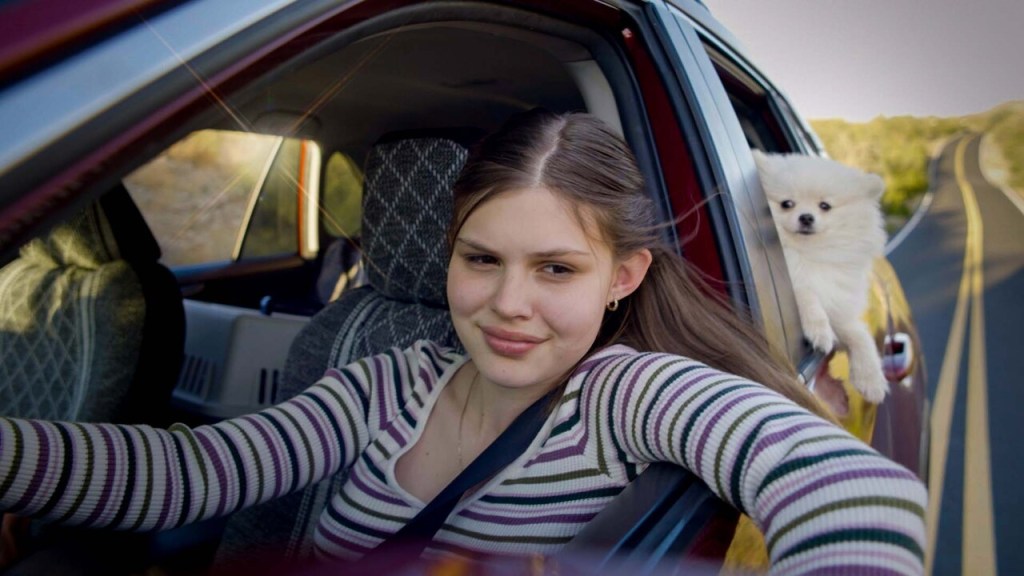
SELAH
Premiering alongside RECONSTRUCTING CHARLIE is SELAH, a coming-of-age road film that follows a teenage girl transporting a designer puppy from Texas to California for cash. What initially appears to be a scrappy road-trip narrative gradually reveals itself as something far more urgent: a story about bodily autonomy, isolation, survival, and resistance.
“We found some striking visuals while filming on the road,” Everly says. “Like the car driving past the most oversized but limp American flag. It felt very ‘this is America’ , so big, so loud and so unsupported.”
Everly describes the film as carrying “Thelma & Louise scrappy road trip energy,” albeit centered on “a teen and dog.”
“It’s a story about freedom on both a macro and micro level,” she says. “Her isolation is an integral part of the journey. It’s her and the puppy against the world.”
The film’s emotional realism extends directly into its visual language. Working with cinematographer Chloe Weaver, Everly rejected artificiality in favor of practical road filmmaking, towing the picture car through the Arizona desert to capture authentic footage on a micro-budget production.
“Chloe advocated for the real thing,” Everly says. “We left Hollywood and road tripped to Arizona with our dog. We towed the car through the desert and leaned into the realism.”
The production itself became physically grueling.
“Just to break any illusion that directing is glamorous,” Everly laughs, “I was riding in the trunk of the car with no AC curled up with my director’s monitor so I could direct discreetly from inside the car.”
The choice to prioritize realism over convenience ultimately became essential to the film’s emotional authenticity.
“We knew that if anything felt staged or fake about the footage, it would hurt the authenticity and narrative of the piece,” she says.
Female Rage, Resistance, and Complicated Women
Across both projects, Everly returns repeatedly to stories about women confronting systems designed to constrain them.
“Simple answer , because of the world we live in,” she says when asked why she’s drawn to stories about women facing impossible choices. “I didn’t choose to be a woman in a patriarchal society but I am and I’m fueled by the injustices.”
For Everly, storytelling itself functions as political resistance.
“Women’s rights and bodies are oppressed and storytelling can be an act of resistance,” she says. “Politics. News. It’s all story. So isn’t it our job as artists to create stories that disrupt harmful and stale narratives?”
She cites writer Nikita Gill’s line, “Bless the angry women who give us hope, who build a better world with their fury,” as something deeply resonant with her own work.
“I’m angry and working toward a better way,” Everly says.
That anger is reflected in her rejection of simplistic female archetypes.
“When I was acting, I always went out for ‘the girl next door,’” she recalls. “The girl next door to whom? A boy, of course.”
She sees contemporary storytelling shifting away from sanitized portrayals of women toward something far messier and more truthful.
“We are seeing much more dimensional, messy, sexual, funny, dark, flawed, angry, powerful, smart women on screen,” she says. “And I’m here for all of it.”
Everly credits her comedy and improv background , particularly her time at Upright Citizens Brigade , for shaping how she approaches emotionally volatile material.
“So much of comedy is exploring and elevating,” she says. “Find the funny and unusual thing and then find ways to heighten it.”
That philosophy applies equally to stories about divorce, grief, cancer, and bodily autonomy.
“Comedy comes from the gap between what a character wants and what is happening,” she explains. “The more that gap widens, the funnier it gets because the challenges increase.”
She compares it to Lucille Ball’s famous chocolate factory sequence in I Love Lucy.
“The faster the conveyor belt goes, the more hilarious it becomes,” she says. “In a way, comedy can be that simple, even with stories about breast cancer and divorce.”
Looking Ahead
Despite increasing industry caution around risk-taking and original storytelling, Everly remains optimistic about where bold personal filmmaking can still thrive.
“I actually think streamers are being brave,” she says. “Cable and streamers is where some of the most radical defiance is happening.”
She reserves more criticism for corporate studio filmmaking and the growing influence of artificial intelligence.
“Studios are the epitome of capitalism, and money wants safe bets like franchises, remakes and sequels,” Everly says. “It’s soul crushing.”
What worries her most, however, is AI.
“I think corporate machines are going to start using it more and more and we will lose the humanity of storytelling,” she says.
At the same time, Everly credits Tribeca’s inclusion and incubator initiatives with actively supporting underrepresented filmmakers and emotionally daring stories.
“They truly nurture these kinds of stories and give artists the resources to go out and make their films,” she says.
For now, Everly’s focus is clear: expansion.
Both RECONSTRUCTING CHARLIE and SELAH are intended as proof-of-concept projects for future feature adaptations, while she also hopes to continue directing television.
“A feature,” she says immediately when asked what comes next. “As long as I’m in this body I want to keep telling stories about the female experience.”
With two standout premieres at Tribeca and an unmistakably original voice emerging at exactly the right cultural moment, Lara Everly is not simply having a breakout year. She is building a body of work defined by emotional honesty, creative risk, political urgency, and unapologetic female perspective , one dark laugh at a time.

