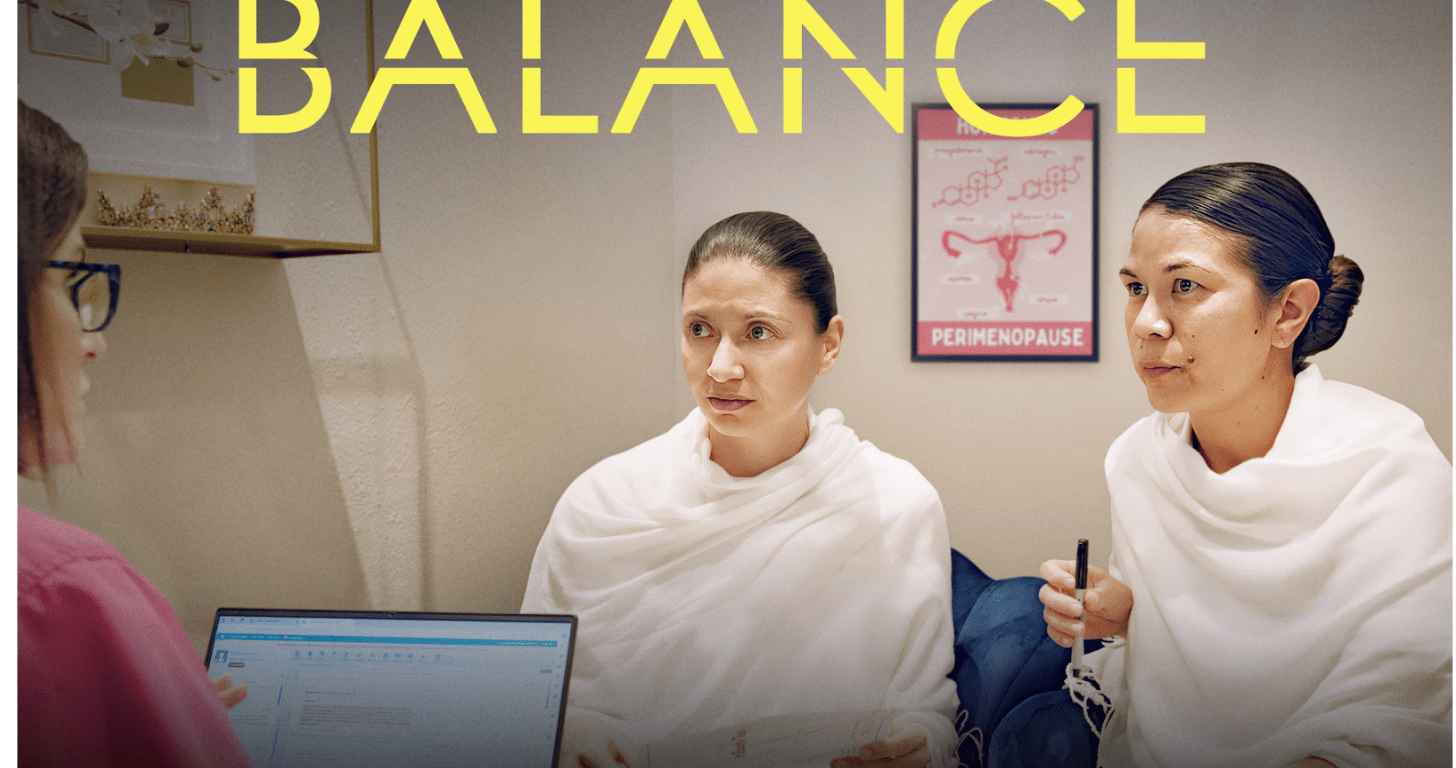
At once deeply personal and socially urgent, BALANCE: A Perimenopause Journey emerges as one of the year’s most resonant and quietly revolutionary documentary series. In a television landscape increasingly driven by issue-oriented nonfiction, this four-part work distinguishes itself not through sensationalism, but through clarity, compassion, and an unwavering commitment to truth.
Created by monk-filmmakers Sadhvi Siddhali Shree and Sadhvi Anubhuti, the series begins as an intimate exploration of their own bewildering experiences with perimenopause before expanding into a far-reaching examination of the systemic failures surrounding women’s hormonal health. What unfolds is both revelatory and enraging: a portrait of millions of women navigating physical and emotional upheaval while confronting medical dismissal, cultural stigma, and a near-total absence of informed public discourse.
What unfolds is both revelatory and enraging: a portrait of millions of women navigating physical and emotional upheaval while confronting medical dismissal, cultural stigma, and a near-total absence of informed public discourse.
What makes BALANCE particularly compelling is the singular lens through which it is told. Siddhali’s background as a former U.S. Army combat medic in Iraq gives the series an uncommon emotional authority. Her instinct for healing, discipline, and inquiry permeates every frame, grounding the documentary in both empathy and rigor. The filmmakers approach the subject not as detached observers, but as women actively searching for answers in real time, a perspective that lends the series remarkable intimacy and immediacy.
Executive produced by Alyssa Milano and Jeannie Mai, BALANCE skillfully balances personal testimony with expert insight from some of the most respected voices in women’s health, including Dr. Mary Claire Haver, Dr. Louise Newson, Dr. Rachel Rubin, Dr. Sharon Malone, and Dr. Vonda Wright. Rather than overwhelming viewers with clinical jargon, the series translates complex medical realities into accessible, emotionally grounded storytelling that feels both educational and deeply human.
Rather than overwhelming viewers with clinical jargon, the series translates complex medical realities into accessible, emotionally grounded storytelling that feels both educational and deeply human.
Visually understated yet emotionally rich, the filmmaking favors honesty over polish, allowing vulnerable conversations and lived experiences to take center stage. The result is a documentary series that feels less like passive viewing and more like collective catharsis. It invites audiences, women, partners, employers, physicians, and policymakers alike, into a conversation long overdue.
Importantly, BALANCE arrives at a moment when the entertainment industry itself is increasingly reckoning with stories historically marginalized or ignored. In that sense, the series functions not only as compelling nonfiction programming, but as a meaningful cultural intervention. Its impact extends beyond awareness into advocacy, giving voice to a demographic too often rendered invisible onscreen and underserved offscreen.
For Emmy voters considering contenders in Outstanding Documentary Series, BALANCE: A Perimenopause Journeyrepresents exactly the kind of purposeful, transformative storytelling the medium is uniquely capable of delivering: intimate yet expansive, informative yet profoundly emotional. It is not merely a documentary about perimenopause, it is a bold corrective to decades of silence.
Margaret Brown

