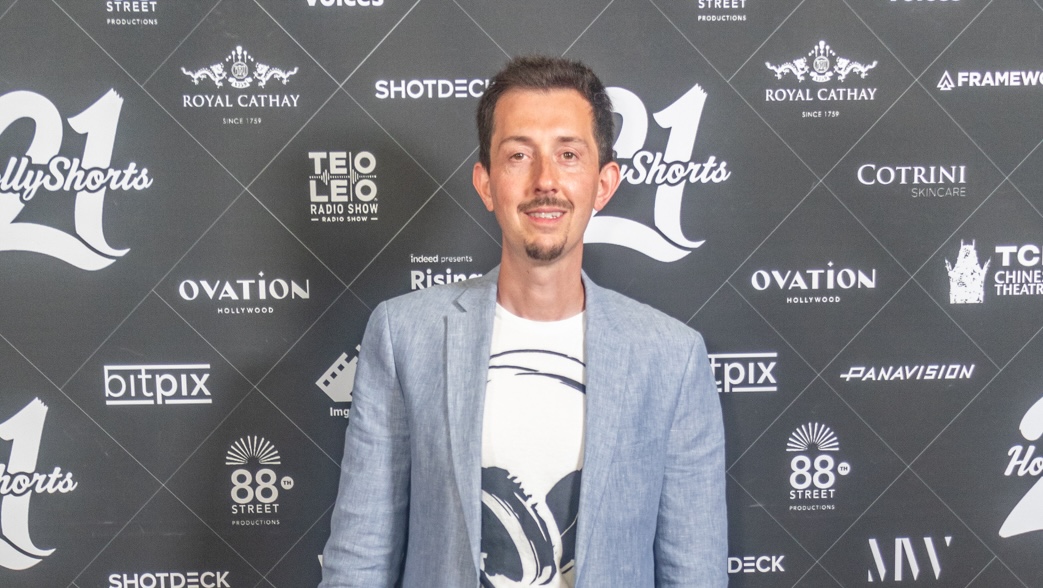
Daniel Persitz paints a powerful portrait of virtuoso pianist Derek Paravicini in Key of Genius. Blind and autistic since birth, Derek communicates through music with astonishing fluency, and the film, based on Adam Ockelford’s memoir In the Key of Genius, captures not only his extraordinary gift but also the transformative mentorship that shaped it.
Oscar-qualified after screenings at Cleveland, HollyShorts, Raindance, and the Los Angeles Diversity Film Festival, Key of Genius has struck a chord with audiences worldwide, celebrated for its authenticity, emotional depth, and nuanced portrayal of neurodiversity. With its intimate focus on Derek and Adam’s unique bond, the film reframes genius not as a solitary phenomenon, but as something nurtured through patience, connection, and belief.
We sat down with Daniel to discuss the inspiration behind the film.

Key of Genius is based on the extraordinary true story of Derek Paravicini. What first drew you to this story, and why did you feel it was important to bring it to the screen?
I come from a family of classical musicians and have been playing the violin since I was five, still performing today with the Santa Monica Symphony. My violinist mom sent me a YouTube clip of Derek playing and I was so struck by it that I immediately read Adam’s memoir about working with him. I fell in love with their story – in the best way, it felt like an underdog sports movie. What really hit me was realizing that music is Derek’s language. It’s how he communicates with the world. As a musician, that resonated so deeply with me.
The film adapts Adam Ockelford’s biography In the Key of Genius. How did you approach balancing factual accuracy with cinematic storytelling?
I was very fortunate to build a close relationship with Adam and Derek – I visited them several times in London and even brought my violin to play music with Derek, which was an incredible experience. I also saw Derek perform several concerts in San Diego. Surprisingly, I found his real story to be so fascinating and cinematic that we didn’t need to stray too far from the facts. Of course, every adaptation requires a few liberties, but Adam was always supportive as long as we stayed true to the essence of his and Derek’s journey.
What role did Derek’s and Adam’s real-life experiences play in shaping your vision as a director? Did you spend time with them or study their interactions in depth?
Meeting Derek completely changed the way I thought about autism, and it was crucial for me to portray his experience as authentically as possible on screen. When we began prepping the film and cast blind actor Cannon Wood to play him, we connected Cannon with both Adam and Derek. Beyond Cannon picking up on some of Derek’s specific mannerisms, that process taught me so much about how a blind person experiences the piano – details that really informed the film’s authenticity. For example, when Derek first approaches a piano, he orients himself by feeling for the pedals, which mark the exact center of the keyboard. From there, he can find any note. Those kinds of details were crucial in portraying Derek’s perspective in the film.
You’ve said this is more than a story about music — it’s about unlocking potential and celebrating differences. What do you hope audiences will take away about neurodiversity from Derek’s story?
What I hope people take away is that speaking isn’t always the way someone best communicates. For Derek, music is his language. I think his story reminds us that everyone has a unique way of expressing themselves – sometimes we just need to discover what that is.
How did you approach portraying autism and blindness with authenticity and respect, while avoiding stereotypes that are often seen on screen?
Portraying autism and blindness authentically was crucial to me, and the key was working hand-in-hand with Derek, Adam and our blind actor, Cannon Wood. To cast Cannon, we brought on Danielle Pretsfelder-Demchick, a casting director who specializes in underrepresented communities. I learned so much from Cannon, both in how to best collaborate with him on set and the unique ways he prepared for the role. For example, his mother had the entire script translated into Braille so he could prepare. One of the coolest things I’ve ever seen!
In what ways does the film challenge conventional perceptions of genius and ability?
What I love about Derek and Adam’s story is that it doesn’t gloss over all the hard work it took to shape Derek into the virtuoso he is today. A lot of stories about autism lean on the idea of instant savant-like ability. Derek was certainly born with extraordinary gifts, but what really makes his story powerful is the years of dedication, patience and persistence that he and Adam put in to develop those gifts. To me, that challenges our traditional ideas of “genius” – it’s not just about talent, it’s also about the work and the relationship that nurtures it.
Derek was certainly born with extraordinary gifts, but what really makes his story powerful is the years of dedication, patience and persistence that he and Adam put in to develop those gifts.

You co-wrote this film with David Seidler, the Academy Award-winning writer of The King’s Speech. What was that collaboration like, and how did his experience influence the script?
Working with David was an incredible privilege. He was such a brilliant writer and he brought a British authenticity to the script – especially the class dynamics, since Adam comes from a more working-class background while Derek’s family is very upper-crust, with his aunt being Queen Camilla. Sadly, David passed away last year but I feel very fortunate to have worked closely with him, even spending time together in Santa Fe where he lived. His influence is deeply embedded in the film.
Music is central to Derek’s life. How did you use sound and score in the film to reflect his unique relationship with music?
One of the things I discovered in researching Derek’s story is that he truly hears everything around him. If we’re sitting in a café, he’s hearing every conversation, the coffee grinder, the milk steaming, the cars honking outside, all at once. It’s almost like a hearing superpower. While that can be overwhelming, it also explains his extraordinary musical ear: when focused, that hyperawareness allows him to hear and perform music in a way no one else can. We designed the sound in the film very carefully to reflect that, so the audience could step into Derek’s perspective and hear things the way he does.
The film is visually stunning while telling a deeply human story. What stylistic choices did you make to capture both the intimacy of mentorship and the grandeur of Derek’s gift?
Visually, I wanted the film to put the audience directly inside Derek’s world. Beyond recreating the feel of 1980s London through production design, we kept the camera primarily focused around the piano. Sometimes uncomfortably close, because music completely consumes him. Early on, when Derek and Adam’s relationship is more combative, the keyboard almost acts like a battleground between them. But as Derek begins to open up, we gradually widen the frame and reveal larger spaces, so the audience feels his world expanding along with the soundscape.
The relationship between Derek and Adam Ockelford is at the heart of this film. What does Key of Genius teach us about the transformative power of mentorship?
Derek was born with remarkable musical gifts but it took the right teacher to help him truly realize them. What Adam gave him was more than lessons: it was belief, structure and patience. And that’s something all of us need. There are so many people who might have incredible abilities that never get developed simply because they don’t find the right mentor or champion. To me, that’s the heart of Key of Genius. It’s a reminder that mentorship can unlock the best in us.
It’s a reminder that mentorship can unlock the best in us.
As a filmmaker, have you had mentors who shaped your own creative journey? Did that personal experience inform how you told this story?
I’ve been lucky to have many wonderful music teachers along the way, including my mother. There’s such intimacy in learning an instrument that you don’t really find in other disciplines. You’re working with hands, technique, sound, all these very personal details at once. That experience definitely shaped how I approached this film. I wanted the audience to feel that same closeness and authenticity in the way Derek learns and connects through music.
I wanted the audience to feel that same closeness and authenticity in the way Derek learns and connects through music.
Key of Genius has already screened at prestigious festivals like Cleveland, HollyShorts, Raindance, and the Los Angeles Diversity Film Festival. What has the audience response meant to you so far?
The response has been really moving. I’ve been pleasantly surprised by how emotional audiences have been at the screenings: people often come up afterwards visibly affected and eager to share what the story meant to them. We also put a lot of care into making the film more accessible, with closed captioning and audio description. One of the most rewarding things has been seeing a broader audience experience the film at festivals and screenings that offer those options.

The film is now entering the Oscar race. How do you feel about Key of Genius being positioned as a contender for an Academy Award?
For me, the goal has always been to share Derek and Adam’s incredible story with as many people as possible because it has so much to say about neurodiversity, mentorship and the power of music. So while awards consideration is of course exciting, I’m especially thrilled about the opportunity it gives us to reach a wider audience.
What do you hope Academy voters, and audiences worldwide, see in this film that makes it stand out?
Derek and Adam’s story completely changed the way I think about both autism and music – not just as art, but as a language and a tool for communication. What I hope Academy voters and audiences see in the film is that it’s not only an extraordinary true story but also an authentic, immersive portrayal of a different way of experiencing the world. If people walk away moved by that perspective, then we’ve truly succeeded.
What I hope Academy voters and audiences see in the film is that it’s not only an extraordinary true story but also an authentic, immersive portrayal of a different way of experiencing the world.
If there’s one lasting message you want Key of Genius to leave with viewers, what would it be?
If there’s one message, it’s that we all speak different languages – and perhaps music is the most universal. Derek’s story shows that connection doesn’t always come through words. Sometimes it comes through sound and through learning to listen in a different way.
Derek’s story is powerful and inspiring. Do you see Key of Genius as the beginning of a larger exploration, perhaps a feature-length project or continuation of this theme in your future work?
Absolutely: Key of Genius actually began as a feature film script. It was voted onto the Hollywood Black List and later optioned by eOne and Lionsgate. Now, we have a financier coming on board to help make the feature and the plan is to be in production by next spring. So this short really is just the beginning!
 FILM & TELEVISION BUSINESS