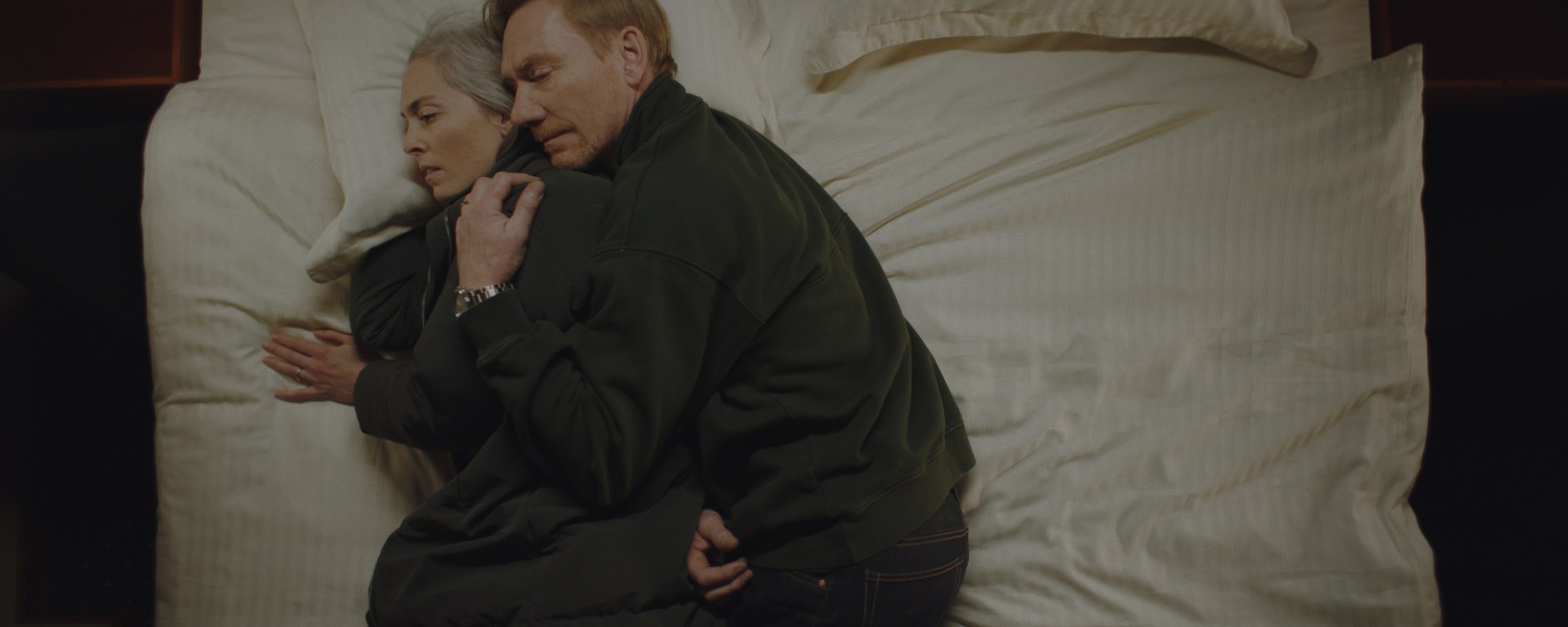
The fact that surrogacy is illegal in Switzerland adds a layer of complexity to the story. How did you approach this sensitive and taboo subject in your writing and direction?
Since UNSER KIND does deal with such a sensitive and taboo subject, it was incredibly important to me to strive for as much emotional, social and medical authenticity as possible. While this can be achieved by thorough research during the writing, it’s really during the production of a film when your credibility and intentions as a filmmaker are put to the test.
Working closely with our talented director of photography Gabriela Betschart, who had previously shot a very moving documentary about surrogacy in India, was key to finding that authenticity when making UNSER KIND.
It was also very important to me to establish a profound trust between me and the cast. I feel trust is the most important resource when shooting a film like this, because it demands so much emotional rawness and exposure from the actors, not only physically but also emotionally.

How much research went into writing the script regarding infertility, surrogacy and the legality of it in Switzerland and Georgia?
Through my studies in Sociology, I learned how to thoroughly research social topics. The key is not to shy away from doing the work: We read any article, scientific paper and watched any documentary, film- or TV segment about surrogacy that we could possibly find, exploring deeply moving stories from intended parents, surrogates, and their children, not only from Switzerland but from around the world. After absorbing these narratives, me and my writing partner Philippe Grob felt emotionally and dramaturgically well enough equipped to write a compelling story.
After completing the script, it was important for me to visit an actual surrogacy clinic in Tbilisi, the capital of Georgia, where we filmed. This experience influenced much of our production design and acted as a kind of test to see if our writing felt authentic. It was also essential to have the medical aspects of the script fact-checked by a fertility expert before we began shooting.
In your research, did you speak to any couples who had gone through the same process?
Yes, I had the opportunity to interview a Swiss couple who had gone on the journey of pursuing their dream of having a family through surrogacy abroad. It was important for me to be able to gain their trust, as it allowed me to not only better understand their personal experience but also to receive their vote of confidence that UNSER KIND tells an important story—even as it explores the moral complexities of surrogacy.

What was the most challenging aspect of writing and directing UNSER KIND, a story about ethical dilemmas?
I think one of the most challenging aspects of making this film was to find an equilibrium between the narrative focus on our main characters – a Swiss couple who is expecting a child through surrogacy in the Republic of Georgia – and our intention to give the surrogate an equal standing; to elevate her position as much as possible and to have her meet the intended parents on the same eye level. This was quite a difficult challenge given the short running time of UNSER KIND.
The relationship between the surrogate and intended parents is incredibly fragile and deeply emotional, and in the context of commercial surrogacy, it also involves a complex power dynamic. On one hand, the intended parents hold economic power, as they are paying the surrogate a significant sum, potentially enabling her to pursue her own dreams. On the other hand, the surrogate holds biological power over the intended parents, as she is the one making their dream of having a family a reality.

How did you help the actors prepare for the emotional intensity of their roles?
I’m incredibly grateful to have worked with such seasoned actors as Lucy Wirth, who plays our intended mother Hanna, Jürg Plüss as her husband Michael, and Beka Goderdzishvili as the surrogacy clinic owner. They are not only talented and versatile but also highly experienced. I fully trusted their ability to portray the complexity of emotions their characters experience. My job was to create a space where they felt safe and well-guided. Rather than over-rehearsing the delicate scenes, we had long, in-depth discussions about the script, their characters, and the underlying themes. These conversations helped me fine-tune the screenplay in return and make it even more authentic.
It was also important for me to have our immensely talented actress for the surrogate, Gano Gerliani, whose performance—despite her young age—is brimming with authenticity and life experience, meet the Swiss actors as late in the process as possible. This ensured that their on-screen encounter felt genuine.
What message do you hope UNSER KIND sends to viewers around the world?
I believe that every couple should have the opportunity to pursue their dream of having a family through surrogacy, as long as the surrogate, the intended parent couple and the child are protected from exploitation; that they can be safe, and all their human rights are fully protected. I personally feel that legalizing altruistic surrogacy, where the surrogate helps a couple not for financial gain but out of compassion, would be a great step forward in countries like Switzerland, where surrogacy is currently prohibited.

Given the illegality of surrogacy in Switzerland, do you hope UNSER KIND sparks conversations regarding the laws around reproductive rights and infertility treatments in your home country?
Yes, I do hope UNSER KIND sparks conversations regarding the law prohibiting surrogacy in my home country. It’s important to note that Switzerland is not an isolated case; surrogacy is prohibited in numerous Western countries. With the growing number of people who remain involuntarily childless—a trend that is statistically significant in many Western nations—the demand for surrogacy is likely to increase in the coming years. In this context, I believe it’s essential to have a serious debate about whether it’s ethically and socially responsible to simply outsource this issue to emerging countries like Georgia, where commercial surrogacy is legal and significantly more affordable than in countries like the U.S.
How did you balance the deeply emotional and personal story of the couple in UNSER KIND with the broader political landscape surrounding such a taboo subject?
To me personally, making the Swiss intended parent couple the main characters of the film felt like the only legitimate access point to this story. And by choosing that point of view, we were automatically forced to confront all the political, ethical and emotional complexities that the underlying topics bring along. Our main goal was to bring the audience to a point where they must ask themselves the question “what would I do in this situation?”, which really can serve as the starting point of a more in-depth personal reflection on the topic of surrogacy or even the participation in a corresponding political debate.
I believe it is so crucial that art does not shy away from confronting topics that are stigmatized or considered a taboo, especially in a time of deepening political polarisation, where the foundation of our democratic system is at risk of being more and more undermined. I personally hope that UNSER KIND serves as a catalyst for change in countries like Switzerland, where surrogacy has been prohibited for a long time, forcing couples to travel abroad in pursuit of their dream of having a family through surrogacy – a journey that can be very consequential not only for the intended parents but also for their surrogate and their child.

