What inspired you to tell this particular story about automation and impact it has on humans, especially in the context of the nail salon?
Our film was created through the Hillman Grad & Indeed Rising Voices Short Film program, where the prompt was ‘What does the future of work mean to you?’ This immediately led us to think of the Vietnamese American nail industry, a world that’s very personal to us. Our family has worked in nail salons for years, and our mother even owned one when we were growing up, so we’ve been immersed in that environment since childhood. It wasn’t until we were older that we fully understood the deep connection between the nail salon industry and Vietnamese American refugees—how it became a lifeline for so many. With this cultural backdrop in mind, we wanted to explore something we’ve been concerned about for years: the struggles of underserved communities, particularly as they face the threat of automation and the impact it has on jobs, livelihoods, and human connections. This film became a way to highlight both the cultural importance of the nail industry and the broader issue of what happens when technology disrupts those spaces.

What do the characters of David and the Vietnamese-American nail tech represent on a larger societal level?
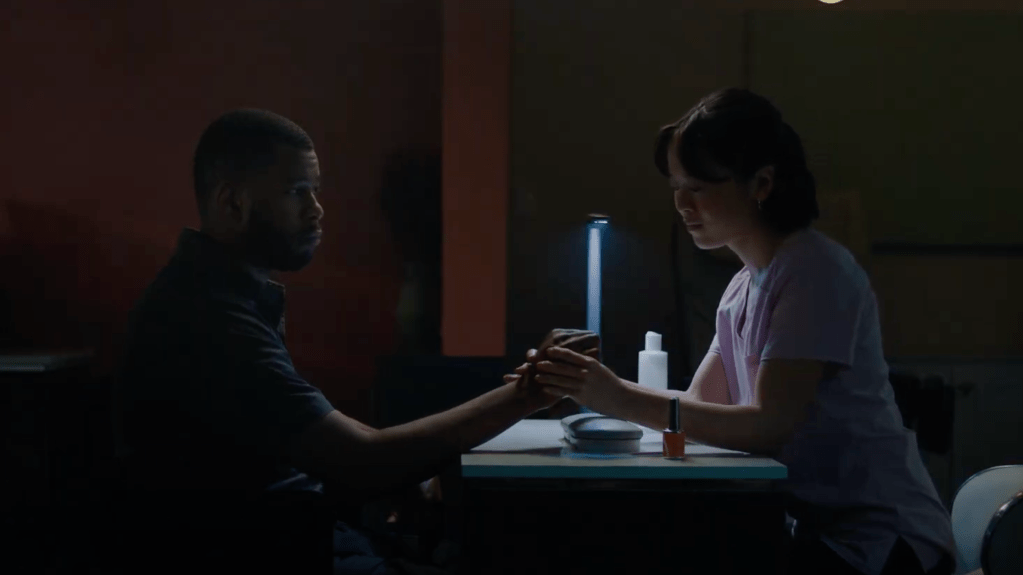
David and Tippi, the Vietnamese-American nail tech, represent the everyday people who make up the 99%—those who are caught in a constant struggle to achieve stability in an increasingly uncertain world. Whether it’s living in fear of losing their jobs due to automation or juggling freelance gigs just to survive, their experiences mirror the financial pressures so many face today. Through their stories, we wanted to explore how these challenges push people to either retreat inward and disconnect emotionally or become guarded and isolated from the community around them.
What conversations do you hope this films sparks?
We hope our film sparks conversations about the value of human connection, especially in an era where economic pressures and technology are increasingly isolating us. The story highlights how important it is to engage with people you might not usually connect with, particularly those whose experiences and struggles may differ from your own. By showing the unexpected bond between two individuals who are initially divided by their circumstances, we want to remind audiences that growth and empathy often come from these types of interactions. We hope it encourages people to be more open, compassionate, and curious about the stories of others.
The film makes reference to cultural identity and economic pressures of being Vietnamese-American. Is there any specific research or personal experiences that assisted the direction of the story?
Our story was largely inspired by our personal experiences growing up as the children of Vietnamese refugees and witnessing firsthand the sacrifices our parents made to build a life in America. Our parents arrived in the U.S. with nothing after the Vietnam War and faced significant hardships, from economic struggles to the harassment they endured as minorities. The nail salon industry became a crucial lifeline for them and many Vietnamese Americans, providing not just a means of survival but a cultural space where they could connect with others. That experience deeply influenced the direction of this film. We wanted to emphasize that working in a nail salon is more than just a job, it’s a key part of Vietnamese-American identity and community. Our film uses that backdrop to explore the broader themes of economic pressures, empathy, and human connection in a rapidly changing world.
How does it feel to have your short film qualify for oscars consideration?
It feels surreal, to be honest. Right now, we’re just incredibly excited about the opportunity this opens up to share our film with a wider audience and gain exposure in the broader film industry. We’re so proud of the story we’ve been able to tell with our amazing team, and the fact that we now have a platform to speak about it and advocate for its message is something we’re beyond grateful for.
What has been the most rewarding part of this journey for you?
The most rewarding part of this journey has definitely been the audience’s response. The feedback has been phenomenal, and it’s incredibly validating to see how our film resonates with people on different levels. Because the story covers a range of themes, audiences have been able to connect with it in personal and meaningful ways, which is the most we can ask for as artists. Ultimately, our goal was to create something that reaches people emotionally, and so far, it feels like Technicians has truly accomplished that. Knowing that our work has sparked that connection is the greatest reward.
What were some of the biggest challenges you faced during production?
The biggest challenge we faced was time. We only had two days to shoot in the nail salon, where the majority of the film takes place, so we had to move quickly and efficiently. That pressure really forced us to focus on the film’s perspective and how we wanted the audience to experience the story. For instance, we had just one hour to film the car chase scene. Ideally, we would have covered it with multiple angles and beats, but the time constraint led us to approach it differently. We decided to shoot it as a ‘oner,’ following the lead character in real-time as he chases his van. This decision gave the audience a direct window into his emotional state—his panic and worry—through his point of view. In the end, we feel that scene stands out because of the creative restraint we had to embrace, making it more intentional and impactful.

How did you work with the production designer to create a visually compelling space that reflects the cultural importance of the nail salon as well as the impending threat of automation?
When working with our production designer, Hanrui Wang, we decided to reflect the cultural importance by showing how it’s been stripped away. At this point in the story, the nail salon has been gentrified by the new owner. The Vietnamese culture that was once present has been replaced by a sleek, modern, and somewhat generic aesthetic. This direction removed any warmth from the salon, making it feel hollow. As if you’re receiving manicures from a company rather than from a human being. The only hints of culture left are through the manicurists themselves. We also collaborated closely with our wardrobe designer, Kim Ngo, to subtly incorporate cultural elements like jade jewelry and a puffer vest— details that quietly reflect the workers’ roots even as the space around them erases it.
What was it like working with Indeed?
Working with Indeed was absolutely phenomenal! From the start, everyone involved with Technicians was incredibly supportive of our vision and voices. Even after the film was finished, they’ve continued to find creative ways to promote our film and others in the program. The film industry can often feel isolating, even for us as co-writers and co-directors, so having that kind of encouragement and backing was not only impactful but also incredibly validating.
 FILM & TELEVISION BUSINESS