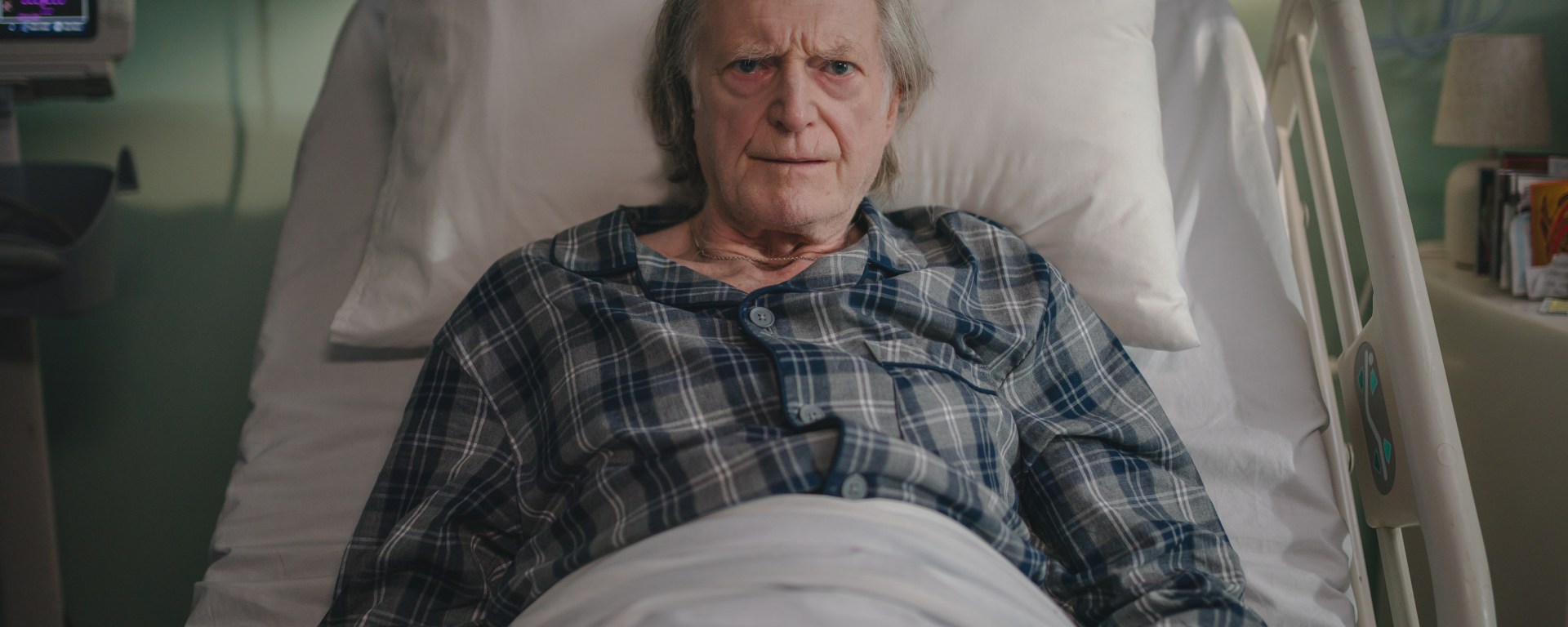
- The time-loop has become a familiar cinematic device, from Groundhog Day to more existential variations on the form. What made you feel it was the right structure for a story about a man in a hospice, and how did you set about making repetition feel like a revelation rather than a gimmick?
Well at first we were drawn to it because the concept felt quite outrageous to us and it gave us that mischievous feeling of ‘can we get away with this?’ We leaned into that, because if something feels like a risk, like it could either make or ruin your career, then it’s probably territory worth exploring. We thought the setting was the perfect place to bring out pathos and tragi-comedy as well as a fresh and unique place to set a time loop. We hope we’ve managed to make the story feel very grounded and real despite the heightened nature of the concept, as the device provided us with a great way to talk about the preciousness of time, when time is at its shortest. Also, usually people in time-loops have a life to keep on living when they come out the other side – Bill doesn’t, and to us that made it an exciting challenge to figure out what we wanted to say about what makes a ‘good’ death.
2. Hospice care is rarely depicted on screen without sentimentality, tragedy or the consolations of a neatly resolved ending. How did you strike a balance between the dark comedy of the premise and the emotional reality of people approaching the end of their lives?
We’re quite proud to have been praised by audience members on our lack of sentimentality in this story (and we think they mean this in a good way!) – but essentially we were so keen to not make a typical ‘old person’ story – we didn’t want to be cutesy or twee and we didn’t want to dwell on the tragedy either because to us comedy and tragedy are inextricably linked – something sad happens one moment then something funny happens the next, that’s just life. We wanted to allow there to be comedic moments that didn’t feel overplayed and emotional moments that felt real – we don’t layer a tonne of musical score over the performances for example, we just let them play out. Everything is as subtle as we could possibly make it whilst still playing comedic or heightened in certain moments. We also laboured over the edit with our editor Hettie Griffiths to ensure our pacing and rhythm was on point – this process really helped with that comedy/tragedy balance and it was about trusting our gut, re-watching it a million times, and getting plenty of notes from trusted friends.
3. David Bradley has a remarkable gift for conveying vulnerability beneath an apparently formidable exterior. What did he bring to the role of Bill that surprised you, and how did you work with him to find humour in a character whose circumstances might otherwise invite only pity?
To us it was David or no one, it was written so specifically for him. He manages to be so likeable whilst being so grumpy, and he’s an absolute hoot of a guy so he completely got the comedy of the script from the get-go. David is also a phenomenal dramatic actor and we were itching to give him a lead role that displayed every facet of his ability – from the grizzled curmudgeon we all know and love, through to showcasing his incredible dramatic chops – he also has so much warmth and cheekiness in him as a person that we knew we could capture that on screen. We were really looking forward to seeing how he portrayed the emotional parts of the script, but wow – experiencing this in the room completely blew us away. He brought so much expression to his face – every eye movement, every lip curl said so much. The man is a legend for good reason.
4. Kat, your experience working in a Lancashire hospice informed the film. Were there particular encounters or observations that challenged your preconceptions about dying, and how did you translate the everyday rhythms of hospice life into cinematic storytelling without compromising its humanity?
There wasn’t a particular experience that shaped the film, but rather a general feeling that I felt differed from the general perception of hospice care. Whenever I saw a hospice on TV or film, it was always so bleak, depressing or scary, but in real life it was actually such a peaceful, safe place, full of love and beauty, with pockets of unexpected joy about the place. I really wanted to capture that.
But to be honest, the initial kernel of the idea was a darkly comedic one, which was “wouldn’t it be funny to make something about a guy who is on his deathbed, being visited by people he really didn’t want to see”. That was a funny jumping off point, but not really a whole film – but luckily the idea evolved and grew into something much deeper that hopefully challenges what people think of when they imagine end of life care.
5. You have built an audience through sketch comedy and work that has attracted hundreds of millions of views. What did making a short film demand of you that writing comedy for television or the internet did not, particularly when dealing with mortality, regret and the possibility of redemption?
Well I’m not sure we can claim we’ve built an audience, but we have created a good amount of viral hits over the years for various charities and brands. For us, we really wanted to make something that wasn’t contained by the limitations of making something for online. With internet sketch comedy, you have to get into the sketch as quickly as possible, make a few jokes and get out – you can’t really tell a full story or explore more complicated ideas, which we really wanted to challenge ourselves to do. We also really wanted to push ourselves as directors to tell a narrative where we had a character grow and change and use the camera to help show that journey.
When you make online comedy, you find yourself just looking at the view count or the comments, but it’s not the same as hearing the laughter (or the sobs & sniffles) in the room. It’s such a great feeling, that we’ve now become quite hooked on. Ultimately, we love sketch comedy, but we want to be making films and TV, so a short was a great way to prove to ourselves that we could do it.
6. The film was self-financed using inheritances from family members who both lived to 100. That is an unusually intimate origin for a film about ageing and legacy. Did the experience of receiving that money change your understanding of what it means to leave something behind, and did it place a particular responsibility on the story you chose to tell?
When we received the money, it was barely a discussion to be honest – we both really wanted to make a film and this gave us that opportunity. Paying for anything out of your own money always adds extra pressure, but when it’s money that has been left to you by loved ones, it really makes you want to make something meaningful. Experiencing the grieving process (as well as some ongoing family health struggles), meant we really had mortality on our minds at the time of writing and producing the film. Creating something positive out of that, by making the best thing we’ve ever made feels really special, because it allows them to play a pivotal part in our success, even after they’ve gone. It makes the whole project even more meaningful to us when we see their names in the end credits. They’re leaving a legacy, and so are we with this film, and we think that’s really lovely.
7. Dark comedy can expose truths that more solemn treatments obscure, but it can also risk making suffering seem glib. Where did you draw the line between finding absurdity in the rituals of dying and making light of the people caught up in them?
That was a massive discussion for us because it’s such a hard line to tread, and to be honest, we weren’t completely confident that we’d managed to do it properly until we’d seen it in front of multiple audiences.
There are certainly moments of comedy that we’ve exaggerated or taken some liberties with to make the humour land, but our guiding light was making sure we got the emotional truth right. We felt that if the jokes were always coming from Bill’s POV and his perception of what was happening, then we would always be on the right lines. And we certainly didn’t want to make light of the feeling of losing a loved one. That’s obviously something we’ve experienced and literally everyone has and will, so we knew we wanted those moments to feel real and honest, and not played for laughs.
Getting the correct balance and tone was the hardest part at script stage, on set and in the edit. We’re quietly confident we’ve got it about right… at least we hope so.
8. With LIFE GOES ON now Oscar-qualified and BAFTA-qualifying, your first short has entered the awards conversation. Beyond the recognition, what would you most like audiences to take away from the film — and do you believe that confronting death honestly can change the way we live, or is that too comforting a conclusion for a film about the end?
Honestly we’re still in shock that we’re even able to mention our names in the same sentence as the words Oscar and BAFTA. But what we’d love is for people to be reminded that we’re all not here for very long at all in the grand scheme of things, so all we can do is try to enjoy life, however long we have, and allow ourselves to be vulnerable with the people who care about us. Because life is all about connection and without that, it’s pretty meaningless.
We hope that by making films that confront death head on, with a little humour and a lightness of touch, that hopefully we make it a topic people can talk about more openly. We’ve been blown away with the reaction we’ve received from audiences, with so many people telling us about their lost loved ones and messages from people across the world saying how watching it felt relatable or therapeutic to them. None of that is what we expected, when we thought we were making something that only we wanted to see. We poured so much of ourselves into this film that it felt incredibly personal to us – we still can’t get over how much its message travels around the world, and we are really proud of how it has connected so much to others.

