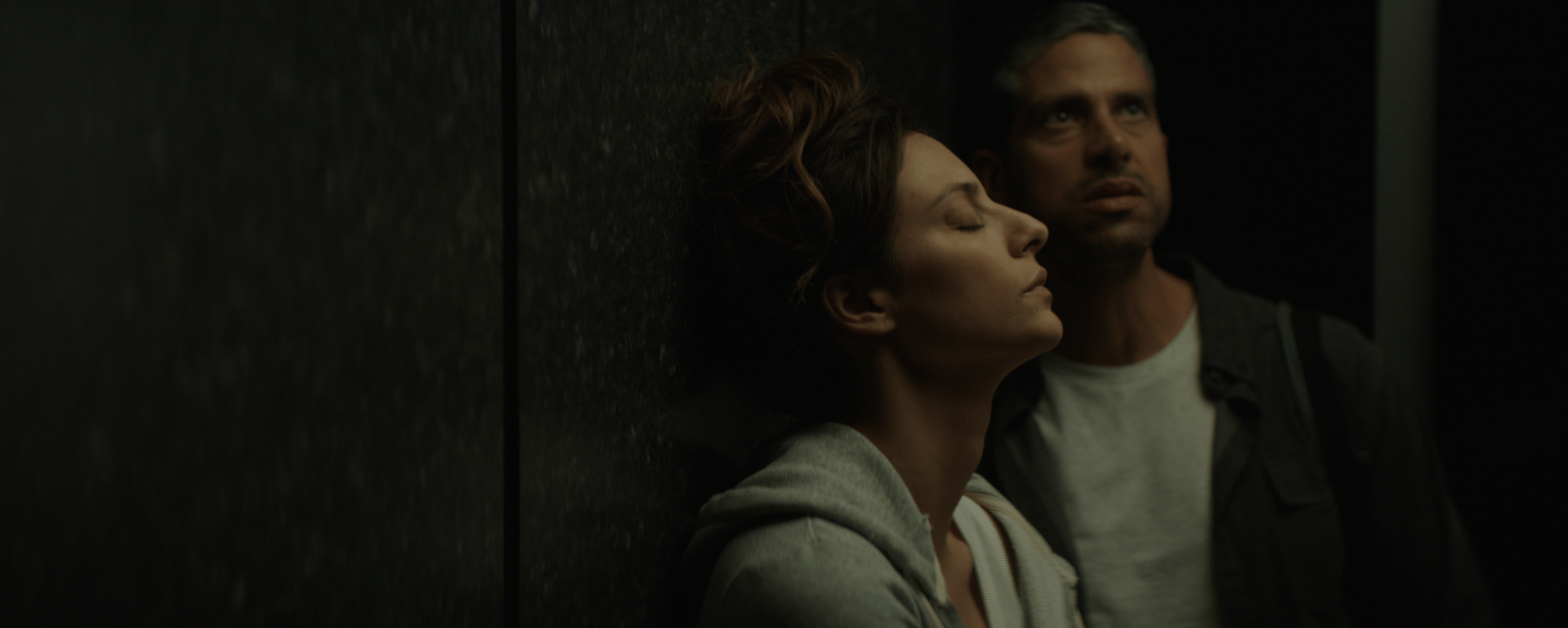
Before You has emerged as one of the most emotionally arresting contenders of the season — an intimate, devastating portrait of a couple navigating the end of a planned pregnancy. The film arrives without spectacle or political framing, instead carrying the soft, unspoken weight of lived experience. It is a work built from silence, color, memory, and the kind of grief that resists public language.
In conversation, writer-director Lauren Melinda traces the film’s origins from personal rupture to a meditation on choice, embodiment, and the emotional landscapes we rarely see reflected onscreen. She speaks with striking candor about the moment her own life split open, the nonlinear rhythms of trauma, and the decision to tell a story that is at once deeply private and urgently resonant.

The Origins of a Story Born from Grief
Before You was born from a moment Lauren Melinda never expected her life to hold. Between the births of her two daughters, she became pregnant again, only to learn the baby had “severe genetic complications.” She and her husband found themselves suspended in a grief that had no public language, forced into what she calls “a decision we never imagined making.”
The weight of that experience lingered for years, emerging in sudden, disarming ways. “I didn’t fully understand how deeply that experience lived in my body until years later, when I was holding my second daughter,” she says. “I felt overwhelming gratitude for her life and, at the same time, a profound grief for the pregnancy that was ended.”
Those unresolved emotions revealed a stark gap in cultural conversation, especially around reproductive care. “The stories we often hear tend to center unplanned pregnancies or political framing,” she explains. “Those narratives matter deeply, but they don’t reflect the full spectrum of people’s lived experiences.”
What compelled her to make Before You was the quietness of this reality, “I wanted to bring that quieter, rarely acknowledged reality into focus… to approach the subject not through politics, but through humanity, love, and the complexity of an impossible choice.”
Telling a Personal Story in a Politicized Moment
Melinda began writing the film before the fall of Roe v. Wade, with no certainty it would ever be made. Writing became a way to process an experience that still felt “very alive” inside her.
After Roe was overturned, the stakes of telling her story shifted dramatically. “I became more aware of the vulnerability of sharing this story publicly,” she admits. The personal became political without her permission. Yet that shift also clarified her sense of responsibility.
“When so much of reproductive care is framed through legislation or ideology, it becomes even more essential to show the human experience at the center of it,” she says. Rather than discouraging her, the changing landscape strengthened her resolve. “What ultimately made me move forward was the possibility that someone who had lived through a similar experience might feel less alone.”

A Photographer’s Eye and the Emotional Logic of Color
Melinda’s foundation as a filmmaker is rooted in her years as a visual artist. “I studied studio art in undergrad and graduate school, and I worked as a photographer for a long time,” she says. Gravitating towards “images that reveal what a character cannot say aloud,” she built a visual language meant to trace the internal experience of grief, memory, and disorientation.
Color, especially, became her primary emotional tool, as a psychological map that pulls the audience through the story’s shifting terrain. That map begins with the soft pinks of early hope, moves into the warmer oranges and ochres that introduce a sense of vulnerability, then descends into the jaundiced, unsettling yellow of the aunt’s house. The film then enters a deep green at the moment of the medical reveal, followed by the washed-out grayscale of the car ride to the clinic, a deliberate suspension of color meant to evoke numbness. When pink returns in the final moments, it is no longer innocent but layered with everything the character has endured.
Working closely with production designer Danny Cistone, Melinda built every set practically and intentionally, ensuring that the actors stepped into spaces already charged with the emotional logic of the film.
The Nonlinear Nature of Trauma
The film’s nonlinear structure arose from Melinda’s own experience of trauma. “Grief doesn’t unfold in order. Memory doesn’t either,” she explains. “When you’ve been through something traumatic, it lives in you in fragments. It surfaces through triggers, through sound, light, or the smallest gesture.”
Writing from that place, she resisted the pull of straightforward chronology. “The nonlinear structure mirrors how the experience existed within me,” she says. “Moments of joy, fear, anticipation, and loss all blur together in hindsight.”
One of the film’s most striking moments, the scene when Maia and Avi walk down the hallway, was also its most technically difficult. “Emotionally, it was the hardest for me to watch,” she says. “That feeling of the world closing in on them.”
Practically, the challenge was enormous. Production designer Danny Cistone built the hallway walls on wheels, and the crew pushed them inward as the actors walked. “Every step had to be perfectly timed,” Melinda explains. “If an actor moved too quickly or a wall came in too soon, the entire illusion collapsed.”
There were no visual effects; everything happened in real time. “I wanted the audience to feel Maia’s psychological pressure in a visceral way, not something conceptual or added in post.”
It’s one of the scenes she’s most proud of. “It captures, in a single visual gesture, the internal collapse the characters are navigating.”

Collaborating with Planned Parenthood and Simbelle Productions
Melinda’s decision to collaborate with Planned Parenthood aligned naturally with the mission behind her production company, Simbelle Productions, an endeavor she created “as a home for women telling stories rooted in emotional truth and social impact.”
Named after her two daughters, Simbelle was always intended to house projects that spark conversation rather than prescribe conclusions. Before You became its inaugural film, embodying that ethos from the start. When the project took shape, Melinda reached out to Planned Parenthood and began collaborating with Caren Spruch, their national director of arts and entertainment engagement.
“She understands how narrative storytelling can open conversations in ways that data or policy cannot,” Melinda explains. Planned Parenthood offered full creative freedom while supporting outreach, helping the film reach communities, often in red states, where audiences connected with the story in unexpectedly profound ways.
The collaboration also reflects Simbelle’s broader growth and ambition. Since completing Before You, the company has expanded into several feature films, including Familiar Touch, which earned two Gotham Award nominations, two Spirit Award nominations, and a partnership with Caring Across Generations, Satisfaction, which premiered at SXSW, and Blue Heron, winner of Best First Feature at Locarno before screening at TIFF.
Across all of these projects, Simbelle continues to champion work that is “deeply engaging and deeply meaningful,” creating films that invite reflection rather than instruct emotion. As Melinda puts it, “We’re not interested in prescriptive messaging… We want to create work that invites conversation—the vegetables tucked inside the chocolate cake.”
 FILM & TELEVISION BUSINESS