
Pier-Philippe Chevigny on slaughterhouses, ex-convicts, capitalism, and the humanity trapped in between
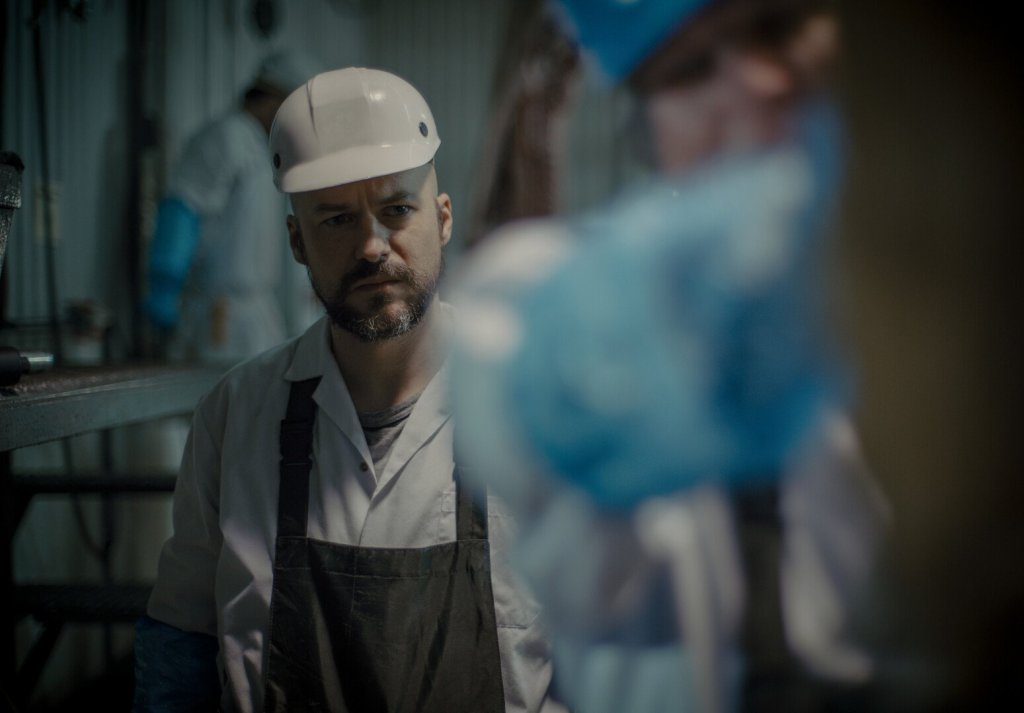
Mercenaire has been quietly but steadily shaking the festival circuit, a film that leaves audiences hushed, unsettled, and morally implicated. With its suffocating realism, its claustrophobic 1:1 framing, and a hauntingly restrained performance by Marc-André Grondin, the film has positioned itself not only as a standout during Awards season, but also as one of the most urgent cinematic works of the year. It confronts the systems that break the people they depend on, and it does so with a clarity that is both brutal and compassionate.
In an extensive conversation, writer and director Pier-Philippe Chevigny traces the film’s origins from personal history to painful research, and unpacks the ethical, political, and emotional architecture behind David, an ex-convict who leaves prison only to find himself caged again by the demands of labour.
The Disturbing Spark, and the Story’s First Life
The initial spark for Mercenaire came unexpectedly from Grondin, who recalled filming in a slaughterhouse staffed predominantly by ex-convicts. Chevigny immediately felt the narrative potential of that environment.
“An ex-convict sent to prison to cure his violence, only to be cast right back into it by a society that finds economic worth in that violence, was profoundly disturbing,” he explains.
But this insight arrived at a moment when Chevigny had already been searching for a way to tell a story about the people he grew up with. His childhood environment was shaped by organized crime, and several of his closest friends drifted into theft, trafficking, and gang violence.
“These were sweet, peaceful kids,” he says, “but the social, familial, and economic contexts they were in pushed them toward crime. It was important for me to show that violent acts do not define who people are.”
Research into slaughterhouses refined the film’s direction even further. Chevigny learned about stunning failures, moments when animals regain consciousness on the processing line. The trauma of witnessing these events left workers with deep psychological scars.
“At that pace, hundreds or thousands of animals per day, errors become inevitable. Several workers I spoke to had PTSD. That is when I knew I had everything I needed to write the script.”

Ethics Over Aesthetics, and the Refusal to Stylize Violence
Chevigny’s approach to violence is grounded in ethics rather than aesthetics. Mercenaire’s suffocating, unadorned style emerged from a desire to make the film difficult to watch in all the ways that matter.
“This is a heavy subject, and the experience of watching it should be heavy too. It should not be enjoyable or visually attractive,” he explains.
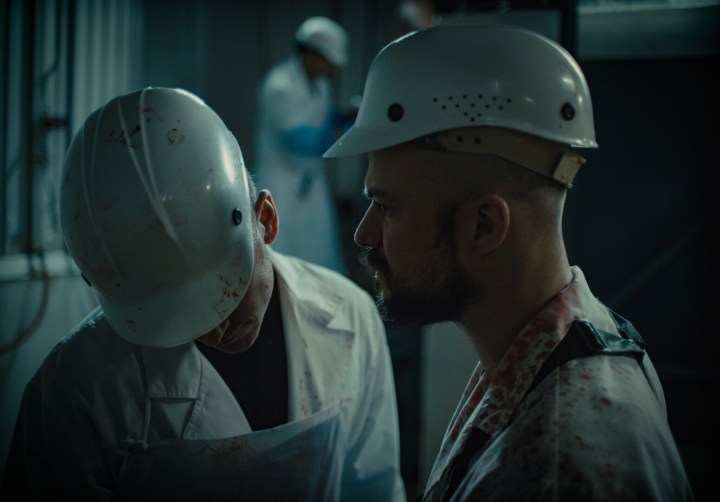
He avoids stylization entirely. Killings happen off-screen, carcasses appear blurred, and the brutality remains only partly visible.
“I wanted to ensure the ethical stance, making it hard to watch, could not be reversed by viewers seeking entertainment. There can be humanity and hope, but never beauty in violence or suffering.”

A Mercenary of Capitalism, and a Life Sold by the Hour
The title Mercenaire draws directly from economic structures. A mercenary, Chevigny notes, is a paid soldier, a person compensated for violence.
“It evokes capitalism, and the idea that society finds a way to utilize the violence of certain individuals for its economic value.”
Across Chevigny’s films, titles often reference war, and this is intentional. He sees his work as a collective exploration of class conflict in which everyone becomes partly complicit and partly victim.
“David is complicit, because he participates in killing animals to feed the machine. But he is also undoubtedly a victim of the system that relies on his violence.”
Balancing Human and Animal Suffering, and Letting Characters Lead
The film parallels human exploitation with animal suffering, yet neither overwhelms the other. For Chevigny, this balance comes entirely from character-driven storytelling.
“What David wants is to re-enter society. Internally, that means letting go of his violence. But externally, society requires him to remain violent. Classical Aristotle, intention versus obstacle.”
He never wanted to impose a political message on the film, preferring instead to let the lived experiences of the characters create social critique organically.
“This keeps the film socially conscious without turning it into propaganda.”
Labour, Reintegration, and the Underbelly of the Meat Industry
Chevigny did not begin Mercenaire with the explicit goal of making an anti-animal cruelty film, although the theme naturally emerged from his research. The process changed his own lifestyle.
“I grew up eating a lot of meat. Now I would call myself a flexitarian. We stopped cooking meat at home entirely.”
Labour exploitation, however, is a theme that runs through all of his work, shaped by his upbringing in a lower-working-class Quebec town. Poverty, crime, and substance abuse were part of his daily environment. His escape came through education, something he knows was not accessible to many peers.
“Filmmaking tends to be a very bourgeois activity. Coming from my background helped my work stand out, and it gave me a perspective that is often absent in the industry.”
The Slaughterhouse as Prison, and the Image as Cage
The metaphor of detention was intentional from the beginning. David is freed from prison, yet he discovers another form of captivity, one created by economic necessity.
This idea informed key visual decisions, including the 1:1 aspect ratio.
“It is an unusual ratio that feels constrained. It traps David, and it traps the audience along with him.”
Shooting in a real, long-abandoned slaughterhouse intensified this dynamic. The location was fully equipped, and workers familiar with the industry helped the crew understand the actual workflow. Live animals also contributed to the realism, although Chevigny made careful ethical choices by using domesticated pigs trained for screen work.
“They were never going to be slaughtered, and they were used to film sets. They even got bananas as rewards.”
Writing, Directing, Editing, and the Rhythm of Control
Chevigny wrote, directed, and edited the film, and sees these roles as interconnected.
“I started as an editor, so I feel comfortable doing it myself. When I write, I imagine the frame. When I direct, I am already thinking like an editor.”
Mercenaire consists almost entirely of long, single takes. This required extreme precision during shooting, because the emotional rhythm of each scene had to function without coverage.
“Editing becomes simpler, because the scenes are autonomous pieces. Wearing all three hats helped me realize the exact vision I had while writing.”
Building a Suffocating Sensory World, and the Art of Controlled Restraint
The immersive, claustrophobic style is a continuation of the language Chevigny explored in earlier works. Cinematographer Simran Dewan and sound designer Simon Gervais developed this atmosphere with exceptional care.
Simran suggested hiring a dedicated camera operator, an unusual choice for independent filmmaking, but one that allowed him to focus on framing and mood. Lighting grew progressively darker as the story approached its climax.
Sound design was equally deliberate. Pigs were recorded during downtime on set, rather than in slaughter environments, to avoid ethical conflict.
“If you watch it in a theatre, the 5.1 surround mix surrounds you completely, making the atmosphere even more suffocating.”
The Fragility in Marc-André Grondin’s Performance
Chevigny wrote the role of David specifically for Grondin.
“I knew exactly what he could bring. I did not need to say much. He understood immediately.”
The film restricts the actor’s most powerful tool, his face, by often framing him from behind.
“All he has is posture, breathing, movement. It can be frightening for actors. They sometimes worry if they do not feel the emotion themselves. But Marc-André trusted the process.”
Documentary Realism, and the Systems Behind the Story
The realism is heightened by the decision to film in an actual slaughterhouse. Although the building was inactive, all machinery remained intact, and workers showed the team exactly how tools and processes were used.
Chevigny notes that Quebec’s meat industry often relies on ex-convicts, a fact many viewers are unaware of. Sociologists told him that some facilities even partner with prisons, employing inmates for far below minimum wage.
“It is not what Mercenaire is specifically about, but it says a lot about the system.”
Empathy as the Film’s Emotional Engine
Above all, Chevigny wants audiences to feel empathy for David, a man who has no advocates, no support system, and no path toward reintegration except the one that re-traumatizes him.
“At its core, Mercenaire is about a man who has no one rooting for him, except the audience. Many shots are framed from behind his neck so the viewer feels physically close, like they could reach out and say, it is going to be okay.”
The Language of Silence, and the Power of What Cannot Be Said
Mercenaire contains very little dialogue. Most lines spoken on the factory floor are deliberately buried under mechanical noise.
“The situations did not require speech. The story could be told visually. The dialogue is almost irrelevant to understanding what is happening.”
Silence becomes its own narrative force, a space where David’s interior struggle can unfold without interference.
A Film That Speaks Softly, but Urgently, Within a Larger Movement
Chevigny does not believe films alone create large-scale social change.
“Change is built over time, through small steps. Films can speak out. Mercenaire participates in that process on a small scale.”
What the film does achieve, with remarkable clarity, is the restoration of humanity to a person society prefers not to see.
 FILM & TELEVISION BUSINESS