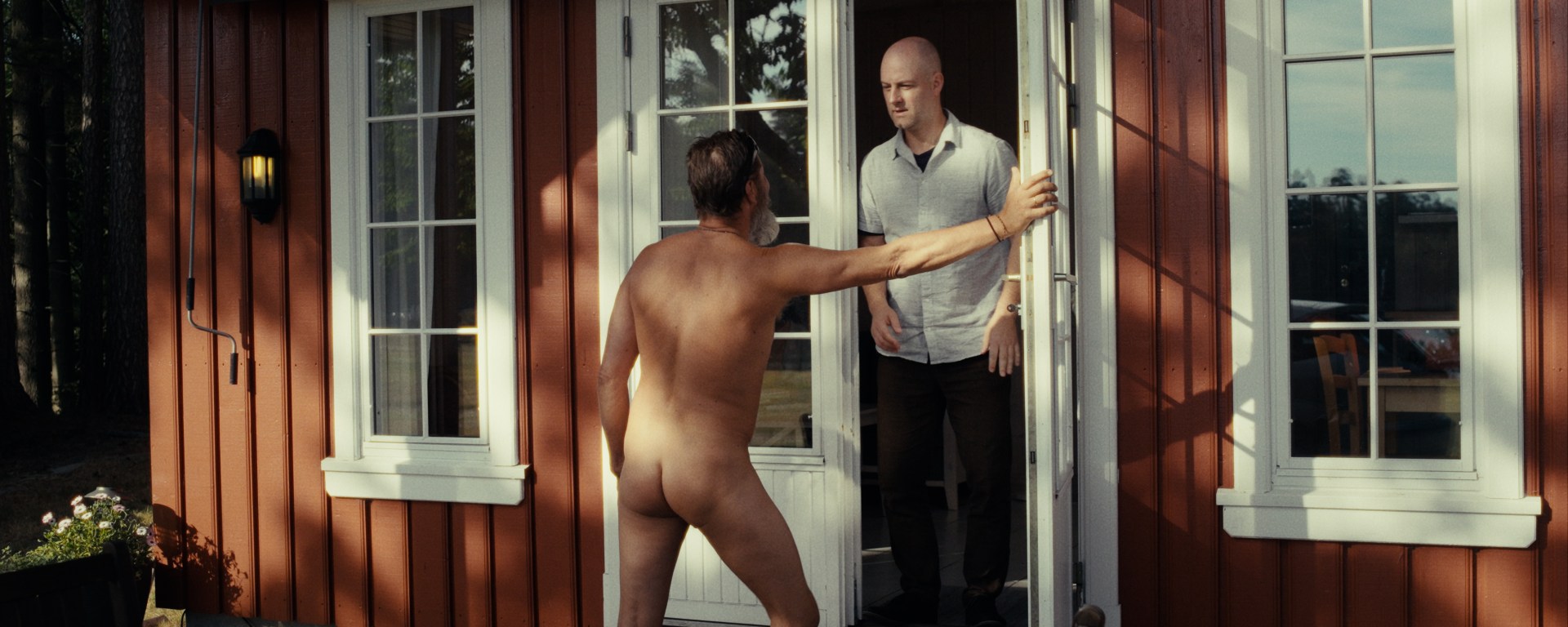

Camping in Paradise is the kind of short film that reminds the industry why the format remains essential. Directed by Oscar nominee Eirik Tveiten, the film takes what initially appears to be a light, comedic premise and shapes it into a finely observed character study about vulnerability, intimacy, and the subtle power dynamics within relationships.
Set in a nudist campsite, the film risks a premise that could easily veer into broad humor or exploitative imagery. Instead, Tveiten approaches the setting with restraint and intention, treating nudity as an unremarkable fact of the environment and using it as a conceptual lens rather than a visual provocation. This grounding choice pays off. Instead of focusing on bodies, the viewer becomes attuned to the characters’ emotional exposure, and the campsite functions as a quiet pressure cooker for everything the main couple has avoided discussing.
Tveiten approaches the setting with restraint and intention, treating nudity as an unremarkable fact of the environment and using it as a conceptual lens rather than a visual provocation.

The narrative centers on a philosopher and his girlfriend who stumble into the campsite and are forced to stay the night. Their unexpected interaction with an overly welcoming resident couple becomes the catalyst for buried insecurities to surface. Tveiten balances humor and discomfort with remarkable precision. The comedy arises naturally from the characters’ genuine awkwardness, never at their expense, and these moments pave the way for more poignant revelations about trust, shame, and the delicate negotiations inherent to long term relationships.
The comedy arises naturally from the characters’ genuine awkwardness, never at their expense
Visually, the film benefits from Gisle Bjørneby’s cinematography, which maintains an intimate, almost documentary sensibility. The camera is close enough to register microexpressions and subtle shifts in energy, yet it avoids intrusion. This visual humility is one of the film’s greatest strengths. It allows the setting to feel authentic rather than theatrical, and it keeps the viewer aligned with the characters rather than observing them from a distance.
This visual humility is one of the film’s greatest strengths.

The performances are exceptionally grounded. Espen Alknes and Mona Grenne convey the emotional fatigue and unspoken anxieties of a couple at a crossroads, while Oddrun Valestrand and Stig Henrik Hoff bring warmth and curiosity to the roles of their campsite counterparts. There is an ease and honesty in the ensemble that suggests a deeply collaborative rehearsal process. Nothing feels forced, and the actors navigate the material with a mixture of vulnerability and humor that feels entirely lived in.
The performances are exceptionally grounded.
From a production standpoint, the film demonstrates the value of a tight, focused concept executed with sensitivity. Producer Heidi Arnesen and Cylinder Production AS create an environment in which bold thematic material can be explored safely and ethically. The film’s logistical challenges, especially given its setting, are invisible in the final product, a testament to thoughtful planning and a clear directorial vision.
Festival programmers have responded strongly, and it is easy to see why. The film operates on multiple levels: an accessible comedic premise, a sophisticated emotional arc, and a visual approach that respects both its characters and its audience. It fits comfortably within the international short film landscape while offering something distinct in tone and theme, especially in its willingness to examine vulnerability without cynicism.
For the industry, Camping in Paradise is further evidence that Tveiten is not merely a filmmaker who found success with Night Ride but an artist with a consistent, evolving voice. His ability to blend humor with emotional depth, and to find cinematic meaning in moments of human awkwardness, positions him as a director capable of handling larger, more complex stories as he moves toward feature filmmaking.
For the industry, Camping in Paradise is further evidence that Tveiten is not merely a filmmaker who found success with Night Ride but an artist with a consistent, evolving voice.
In a crowded short film market, Camping in Paradise stands out for its clarity, its empathy, and its subtle daring. It is a small film in scale, but one with surprising resonance, and it reinforces the continuing relevance of short films as vehicles for sophisticated, risk taking storytelling.
 FILM & TELEVISION BUSINESS