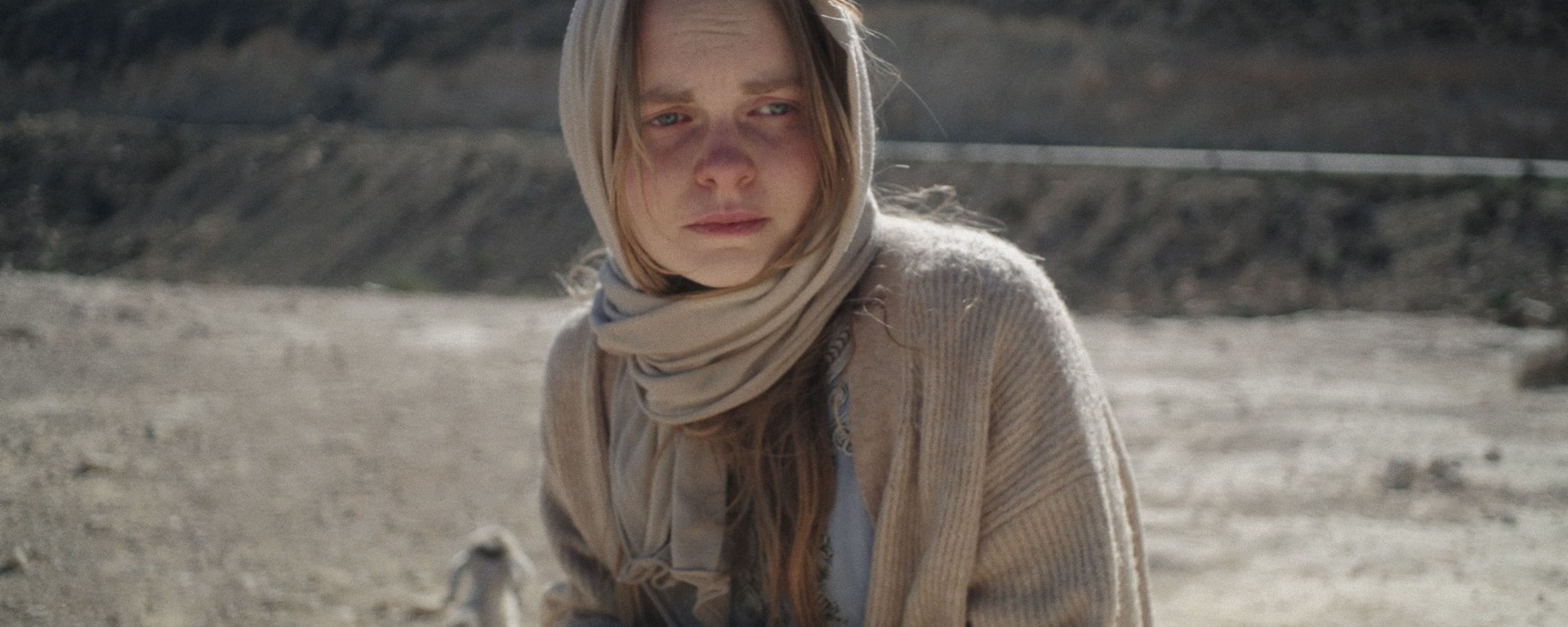
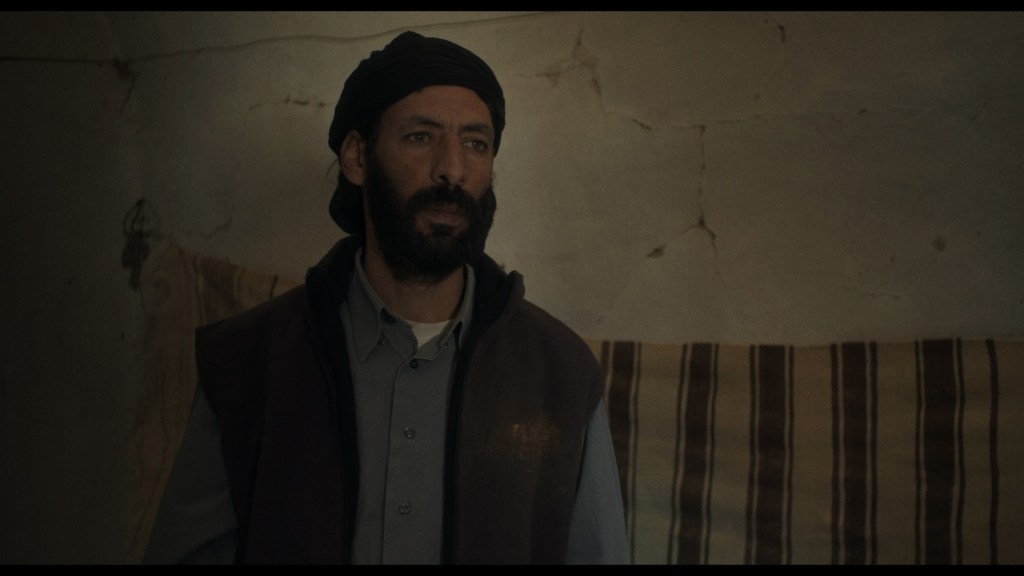
With their short film WALUD ولود, co-directors Daood Alabdulaa and Louise Zenker have crafted one of the most arresting and quietly unsettling works to emerge from the international festival circuit this year. Recently qualified for the 2026 Academy Awards, the film continues to gather momentum as it screens at Oscar®-qualifying festivals including Santa Fe, Aesthetica, Norwich, FeFF and EnergaCAMERIMAGE. Set in the rural Syrian desert during the height of ISIS control, WALUD explores the emotional terrain of womanhood under extreme patriarchy, weaving a tense domestic drama around infertility, power, and silent endurance.
The film follows Amuna, isolated with her ISIS-fighter husband Aziz, whose fragile sense of security shatters when he brings home a second wife, Alina, a European convert. Shot with stark, haunting visuals by cinematographer Henri Nunn, WALUD interrogates how systems of oppression extend beyond physical violence into the intimate spaces of marriage, fertility, and social value. Its title, an Arabic term meaning “able to give life”, serves as a pointed reminder of how womanhood is often reduced to biological function.
Much of the film’s thematic potency stems from Alabdulaa’s own biography. Born in the Syrian desert in 1994, he was raised as a girl until age seven due to his mother’s longing for a daughter. After fleeing Syria in 2014, he sought asylum in Germany and now studies directing at HFF Munich, centering stories shaped by Middle Eastern social realities. Zenker, who also grew up in a rural village in southern Germany, brings a complementary lens shaped by academic research and television experience. Since beginning her feature directing studies at HFF Munich in 2021, she has collaborated with Alabdulaa on both nonfiction and fiction projects, including Fata Morgana.

We caught up with the talented directors to talk about this brilliant short.
How does ‘WALUD’ uniquely depict the cultural intricacies of shepherd life in the Syrian desert, and what were the challenges in portraying these authentically?
The film centers around a Syrian couple in their mid-forties living in a rural part of Syria – more specifically the eastern desert of Syria where Daood Alabdulaa grew up. As we wrote the script, we talked a lot about the way life works in this specific part of the world where you’re next neighbour might live about 4 kilometers away – while the region is facing political turmoil due to the civil war raging in the country as well as the ISIS being in control in that part of the country. This specific set up creates a prison without walls. The empty vastness hides the fact that there is a tight knight community that knows everyone very well which adds to the invisible walls because it does add social pressure.
We always saw our main character Amuna as someone who used to be an English teacher in the village’s school and who – when ISIS took over the region and her husband joined their forces – had to stop working and retreat into the private sphere of their home. So she took over her husband’s job of taking care of the sheep while he now leaves their home in order to earn money by fighting alongside ISIS. Being a shepherd in this situation means that most of the product you might get from the sheep will feed your family and might not be turned into money.
For more specifics about the shepherd’s life, we added more details within the next answer, but turning towards the challenges: The major challenge was for sure that we could not shoot in Syria. We shot the film in January 2024 before the fall of the Assad’s regime so we had to find a different country where we could put together a crew within a nature that resembles Daood’s place of birth as closely as possible. As we are a student production with a very limited amount of money Marroco was not an option but we landed in Tunisia as it offered the opportunity to find similar buildings and huts as well. We were lucky enough that the building we were shooting in had a herd of sheep attached and the owner of the sheep agreed to help us herd the animals for all the shots that we needed. All in all Daood’s memories and instincts led us to the way we included the daily life of shepherds into the film.
As a director with personal ties to the Bedouin community, how did Daood Alabdulaa’s background influence the storytelling of ‘WALUD’?
Daood Alabdulaa grew up in the eastern Syrian desert and lived through the ISIS regime in the region. As his family is part of the Bedouin community he grew up in the desert with no close neighbours but with a lot of animals and as a kid he spent endless days herding the sheep with his brother. Daood has always been very curious to tell stories that are set in the world of his community without using the stereotypes that we might be used to seeing in media when we talk about Bedouines which often includes a heavy focus on animals and living in tents.
There is a very specific bond between the Bedouin community and nature as well as the animals. While it is not the same bond we might find in western countries of a romanticized relationship between human and animal, it is more of a deep understanding that the Bedouin communities do not own the nature or the land but can still walk freely and use it with their animals and therefore respect it.
We always knew that we wanted to place the story in a similar setting to Daood’s youth and create a film that captures the way civil war impacts the communities in rural areas which do not appear on the news that often because the destruction is a lot more invisible – yet very forceful. It comes in distant fights, in the feeling of being trapped in the desert due to planted land mines and we implemented this feeling into the way we framed and edited the film.
At the same time on a very different level Daood’s childhood in the desert – the endless hours of just existing within a nature that offers very little entertainment heavily influenced the pacing of the film walud. We were searching for a silence that is specific for the people living in the eastern Syrian desert who might know each other very well and can withstand the silence of not talking to each other.
The film renders Daood’s memories and his urge to understand a political chapter in his life (the rise of ISIS and also the arrival of European ISIS soldiers) into a story that mirrors political changes and the resilience of Bedouin people without portraying them as exotic. It is tied to the fact that especially in the eastern regions of Syria people might be more conservative which often means that female voices, needs and dreams are neither heard nor respected -while these women often embody a great silent strength and resilience.
How does Louise Zenker’s focus on feminist and political themes manifest in the narrative of ‘WALUD’?
Louise Zenker was part of the writing process from the very beginning. As the two of them work and live together, writing and creating a story can not be credited to either one of them alone – but the story, structure and the visuals rise from hourlong discussions over multiple months. On the one hand, it was important to include a female voice into the film as especially everything related to the topic of childbirth, menstruation and the pressure to bear children with all the tied emotions and struggles is something that a man can potentially imagine but never feel.
At the same time we wanted to create a film that is both: authentic to Daood’s vision and understandable and relatable to a western audience. So we decided to integrate a western young girl into the story as a bridge between both words – but also – as an invitation for a western audience to understand that we are all intertwined with each part of the world. As a European storyteller Louise holds the belief that by creating stories together we can focus on our (historic) responsibility as the so-called western world while emerging ourselves in worlds that seem to be so different from what we might call home.
Overall it is quite hard to separate both our influences on the story from each other as the film in itself is very much the result of two people with a very different upbringing working together from the start till the finish line in a constant exchange of ideas, visions and realities.
The title ‘WALUD’ is rich in symbolism. How does this duality of hope and tradition play out in the film’s narrative?
As we were writing the film, we ran into discussions regarding the end of the film – not being sure if we wanted it to be hopeful or not – but ultimately decided that within the current political situation hope needs to somehow find a way to be alive. We think that by giving the European girl Alina a chance to flee we mirror the global political situation that – so far – the so called middle east has fared worse than western countries even if both regions were part of conflicts – or in the case of colonialism – western countries moved into eastern countries, created conflict and suffering and were able to leave after all.
We do believe that our main character Amuna – by staying in the country, standing tall even though she has been hurt by her husband, embodies the way in which people of the middle east do not want to leave their home and their country because they do believe that with the right people things might chance for the better – but they most certainly will not, if everyone leaves.
Why do you think ‘WALUD’ resonates with audiences worldwide, and what universal themes does it explore?
We are so glad that this film does resonate so well. Looking at it now, we do think that the portrayal of silent resistance within an oppressive system – sadly – turns out to be more and more a thing that is relevant in people’s lives all over the world. With the rise of right wing politics – especially regarding female rights and the right to have control over one’s own body the film is about a topic that moves a lot of people all around the word – while being set in a very specific, very extreme situation. It might function as an example of what sort of systems humans can create, while offering the narrative that resistance is possible and that we will only survive if we find human solidarity with each other.
Winning the Best International Short Film at the Female Eye Film Festival is a significant achievement. What does this recognition mean for ‘WALUD’ and its creators?
We were so honoured to win this award! Especially at a festival that focuses on stories about women and / or told by women. The Female Eye Film Festival is one of the most important festivals focusing on female issues and empowering female voices from around the world and it feels like a huge compliment to win this as a directing-duo as we worked hard to create a film that finds the right balance between being political, emotional, true to the harsh reality of living in patriarchal extremist groups while still offering some sort of hope and honouring female resistance around the world.
 FILM & TELEVISION BUSINESS