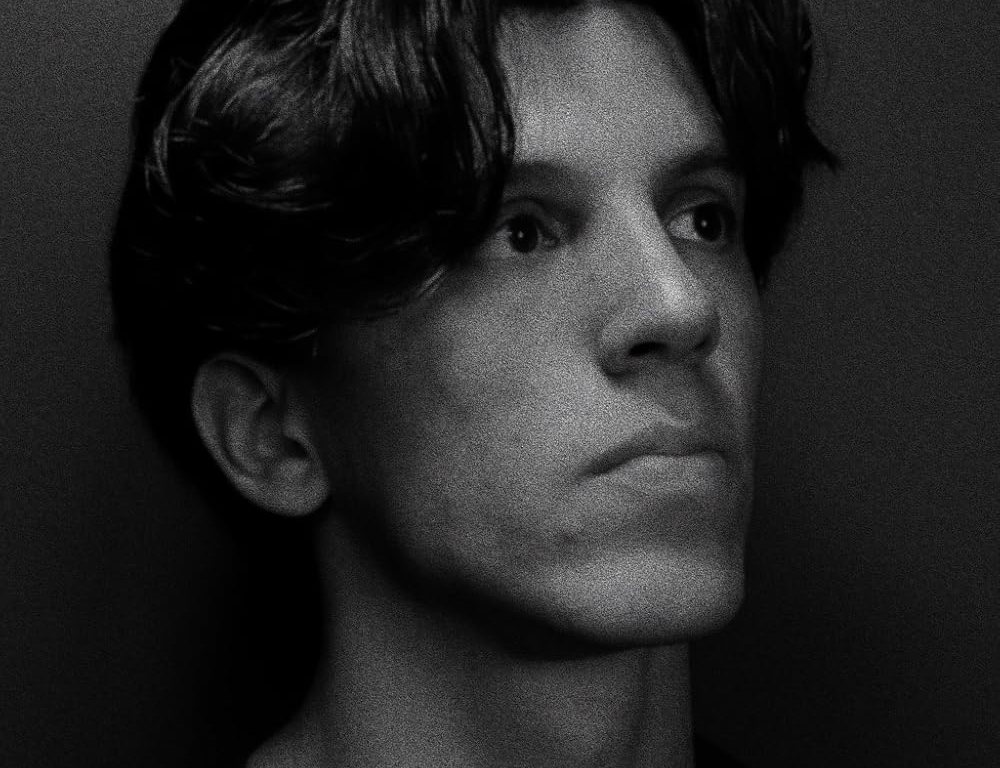
Luís Hindman’s MAGID / ZAFAR announces a filmmaker interested in interior scale, stories that feel expansive without leaving the room. The BIFA-winning, BAFTA-nominated short unfolds across a single night inside a British Pakistani takeaway, but its impact comes from the density of detail, the precision of sound and the emotional architecture underpinning every creative decision.

For Hindman, the physical space was never simply a location, it was the film’s central design problem. “The key thing I needed was total control over shaping the location to what the film required,” he explains. The production found what he describes as a blank shell, “a kind of carcass onto which we could design an entire world from scratch.” Although the space was not originally a South Asian takeaway, its layout offered distinct rooms for each stage of the story and unusually high ceilings that allowed constant overhead lighting rigs, “as if we were on a soundstage with no ceilings at all.”
From that base, the takeaway was constructed in meticulous detail. Hindman credits production designer Luke Moran-Morris and art director Charlotte Ball with creating a highly specific environment through photographic layouts and 3D builds. “Everything you see on screen, down to the tiles on the walls, wallpaper, chairs, frosting on the windows, menus and graphics, was deliberately designed and dressed,” he says. Because the narrative never leaves the space, the environment needed to sustain itself completely. “There was no room for error, it had to be believable with no compromise. There’s nowhere to hide.”
Hindman approached the setting as a series of emotional ecosystems rather than one continuous location. “I broke the space into three distinct environments,” he explains. “The kitchen had its own rhythm and language, the customer-facing area operated differently, and the pantry carried yet another energy.” Each zone was treated separately across camera movement, colour palette, soundscape and performance style. The intention, he says, was “to build something expansive and immersive, giving the film a scale that feels much larger, both cinematically and sensorially, than the physical space itself.”
Sound provided the foundation for that expansion. Hindman describes his process in instinctive terms, “I hear films before I see them, so music and sound is always my initial entry point into building a cinematic world.” The soundtrack grew from realism, what would actually be playing in those spaces, but evolved into something more deliberate. “I wanted the film to feel like a mosaic of British Asian culture spanning generations,” he says. “Using music felt like the most natural way to express that.”
His references were explicitly cinematic. “I wanted to approach South Asian music with the same sense of dynamism and cinematic charge you find in the soundtracks of filmmakers like Tarantino or Scorsese,” Hindman notes, describing the excitement of constructing a sonic world where Swet Shop Boys, M.I.A and Nusrat Fateh Ali Khan could coexist seamlessly. The result is a soundtrack that behaves less like accompaniment and more like narrative structure, shaping rhythm, memory and emotional release.
That same structural thinking informs the film’s exploration of masculinity. Hindman was drawn to the idea of code-switching as performance. “I was interested in exploring code-switching and male performance within a hyper-masculine cultural environment,” he explains. The character’s arc was designed around perception. “I was particularly drawn to presenting one version of a character at the beginning of the film and then gradually overturning that perception by the end.” The film’s interrogation of the “British bad boy” becomes less about subversion for its own sake and more about revealing emotional interiors that remain socially concealed.
Performance was built through conversation rather than instruction. Hindman worked closely with Eben Figueiredo and Gurjeet Singh to construct shared history off screen. “I had detailed one-to-one conversations with each of them about their character’s backstory,” he says. Workshops and rehearsal provided space for exploration, but the emphasis remained on trust. “It was really about giving them all the information they needed and then fully trusting them to shape and embody the characters in their own way.”
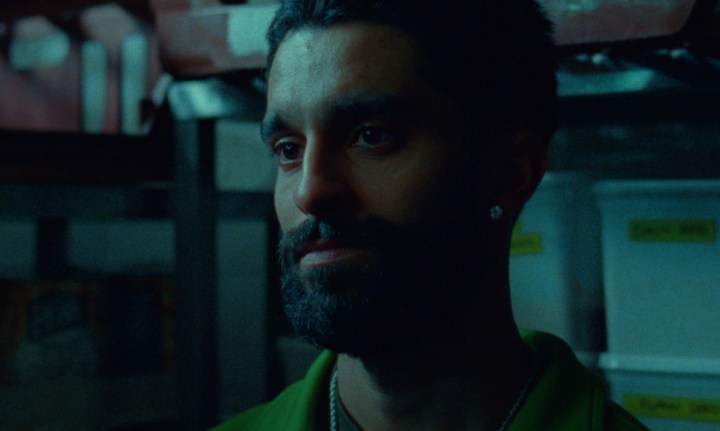
The visual strategy mirrored that philosophy of gradual revelation. In collaboration with cinematographer Jaime Ackroyd, Hindman established a clear rule, “no wide shots, at least not until the very final frame.” Rather than presenting the environment in a single establishing image, the space is discovered through fragments. “The environment is absorbed in pieces, through textures and fleeting details,” he explains. “By accumulating tight close-ups and detail shots, we could create an impression of the setting that mirrors the character’s psychological experience.”
Shooting on 16mm was central to that intention. Hindman describes the format as “full of both grit and beauty,” capable of embracing mixed colour temperatures while maintaining a sense of movement even in stillness. The visual texture reinforces the film’s thematic concerns, instability, pressure and emotional residue embedded in everyday environments.
Importantly, MAGID / ZAFAR was conceived without the expectation of expansion. “It was conceived as a standalone statement,” Hindman says. The recognition that followed, BIFA, BAFTA and major festival selections, has shifted visibility more than direction. “It’s been great and is just more encouragement to keep making personal, uncompromised films.”
That commitment is rooted in perspective. Hindman speaks openly about how his South Asian and Northern Irish heritage shapes his storytelling. “My perspective on the world is always going to be through the lens of cultural specificity and immigrant experiences,” he says, positioning identity not as subject matter alone but as creative methodology.
What emerges through MAGID / ZAFAR is a filmmaker attentive to how cinematic worlds are built from detail, sound, performance and emotional geography rather than physical
 FILM & TELEVISION BUSINESS