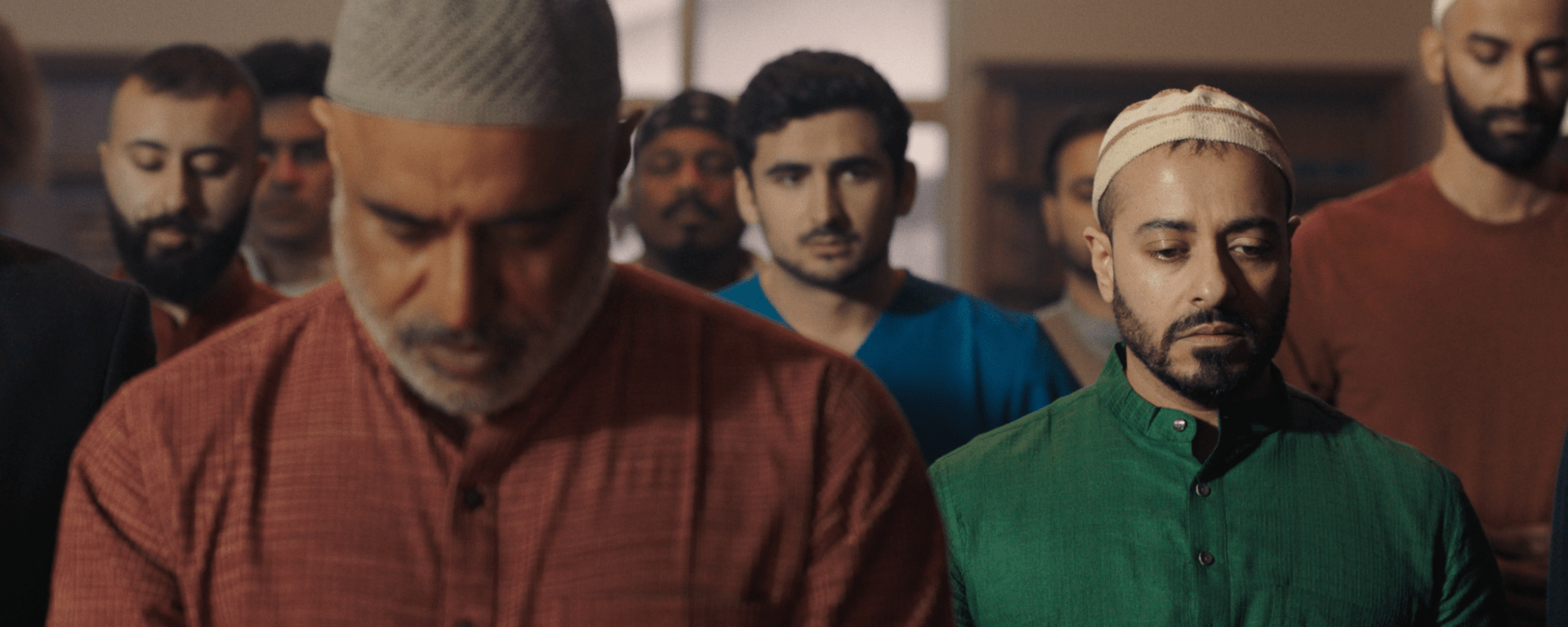
In this interview, director Radha Mehta discusses her powerful short film WITNESS that made its European premiere at London’s 2025 Raindance Film Festival.
WITNESS explores a quiet moral reckoning within a devout Muslim community—what initially inspired you to center the story on an imam and a trans man seeking spiritual belonging?
WITNESS was born from a deeply personal place—originally written by Saif Jaan, inspired by a reimagining of his own lived experience as a trans Muslim immigrant navigating the search for spiritual belonging. After attending his sister’s nikah, Saif quietly entered a mosque and joined the men’s prayer. In that simple act of prostration, surrounded by those who looked like him and shared his language and faith, he felt something rare: peace, safety, and a sense of home.
Yet, that moment came with a cost. He knew that, had his identity been known, he might not have been allowed to stay. That tension—between being seen and being safe, between being Muslim and being trans—became the emotional root of the film.
What fascinated both Saif and Radha, who co-directed and produced the film, was the quiet moral dilemma that often confronts religious leaders: how to honor sacred tradition while protecting the evolving needs of their community. The imam in WITNESS is not written as a villain, but as a man who must wrestle with his own interpretation of doctrine when it conflicts with compassion. He is guided by love for his congregation, but his beliefs are tested when that love reaches someone his teachings have told him not to accept.
By centering the story on the imam’s point of view, the film invites audiences—especially those unfamiliar with trans or Muslim experiences—into a space of empathy. It asks: Can a leader evolve and be accepting without betraying his faith?
The trans character in WITNESS does not need to change. His existence is not a question, but a quiet truth. It is the world around him—and those who claim to guide it—that must reckon with their reflection.
In a cinematic landscape where conflict is often externalized and loud, was it important to you to not dramatize the imam’s crisis in purely overt or theatrical ways?
In a cinematic world where conflict is often externalized and amplified, it was absolutely important for us to approach the imam’s moral crisis with subtlety and restraint. WITNESS is a film about inner transformation—about a quiet reckoning within a man whose entire sense of spiritual order is being gently but profoundly challenged. To overdramatize that journey would have risked losing the very essence of what makes it powerful: its stillness.
Both Radha and Saif believe in the strength of subtext as a storytelling tool. We’ve found that when a story whispers rather than shouts, it invites the audience to lean in, to engage more deeply, and to discover meaning between the lines. Loudness can often alienate, but subtlety has the potential to disarm—and that’s what we aimed to achieve with this film.
This approach was deeply supported by our collaboration with Director of Photography Nausheen Dadabhoy and Production Designer Mehdi Bennani. Through their sensitive and intentional contributions—lighting that feels like quiet revelation, framing that holds space for internal conflict, and design choices that build a lived-in world—we were able to reflect the tension and tenderness at the heart of the story without resorting to overt dramatics.
Ultimately, we wanted WITNESS to feel like a sacred space—one where silence carries weight, and where transformation happens not through spectacle, but through quiet, deeply human moments of recognition and choice.
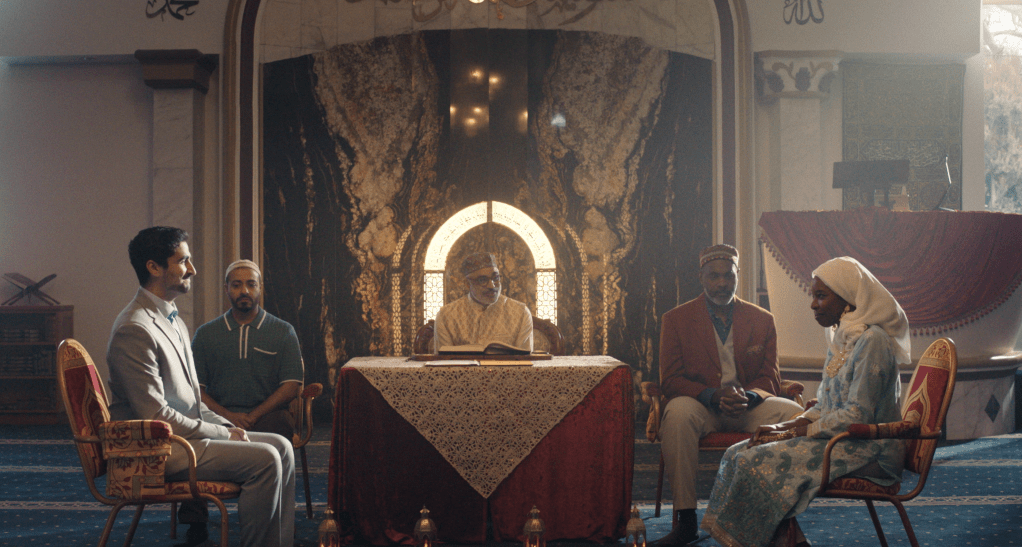
The film tackles tension between religious doctrine and compassion. How did you navigate the line between critique and reverence when portraying the imam’s internal conflict?
Navigating the portrayal of the imam’s internal conflict was never about positioning religious doctrine in opposition to compassion. In fact, one of the foundational principles of Islam is mercy—Ar-Rahman, Ar-Raheem—the Most Compassionate, the Most Merciful. So for us, the tension in WITNESS isn’t between faith and compassion, but between rigid interpretations of that faith and its core, compassionate truth.
The imam’s journey is about returning to the heart of his belief system. His conflict reflects the weight of community expectation, cultural rigidity, and inherited fear—not a flaw in the faith itself. This is especially evident in a pivotal moment when he hears a child recite verses from the Quran. That voice—pure, uncorrupted by social conditioning—serves as a reminder that the sacred text is rooted in love and inclusion.
We were intentional about every religious element in the film. Our producer, Omar Al Dakheel, brought his deep knowledge of the Quran to ensure that the verses we used were both accurate and layered—open to interpretation, yet undeniably grounded in compassion. These choices were never for shock or provocation, but to reflect that even within scripture, there is room for nuance and reflection.
Faran Tahir, with his lived experience and deep connection to the material, brought this duality to life with quiet strength. His portrayal of Imam Mustafa invites viewers to witness not a man torn between right and wrong, but one learning to realign with the very spirit of his faith.
For us, WITNESS is not a critique of Islam—it’s a reflection on how faith, when returned to its essence, can be a path to deeper empathy, healing, and belonging.

The score in WITNESS feels intricately woven into the emotional landscape of the film. How did you collaborate with composer Omar El-Deeb to drive the tension and atmosphere of the film?
Collaborating with composer Omar El-Deeb on WITNESS was a deeply intuitive and layered process. Omar, an accomplished Egyptian composer and multi-instrumentalist with experience scoring Netflix films and series, brought a rich cultural and emotional sensibility to the film. His ability to weave mood, restraint, and tension through music made him the ideal partner for this story.
With Radha’s background in music and Saif’s emotional clarity as the writer, the foundation of our collaboration was built on a shared understanding of the film’s emotional rhythm. From the start, we knew the score had to feel like breath—something that could rise and fall with the imam’s inner journey without ever overpowering it. We wanted the music to guide the audience inward, rather than signal them how to feel.
Radha and Saif created a playlist of reference tracks early in the process to explore the world and tone of the soundscape. After picture lock, Radha temped the film with a gentle, ambient palette to convey the subtle emotional architecture they envisioned. Omar then took those references and elevated them into something wholly original—using his own voice and instrumentation to create a sound that felt sacred yet restrained, intimate yet expansive.
Though the story unfolds entirely within the walls of a masjid, Omar’s score helped expand that space—giving emotional depth and atmosphere to a film rooted in stillness. The result is a soundscape that doesn’t just support the story, but becomes part of its spiritual fabric.
How did your own personal relationships with faith—whether fraught, reconciled, or ongoing—influence the emotional core of this film?
The emotional core of WITNESS is deeply rooted in each of our team members’ personal and evolving relationships with faith. This was not just a film about spirituality—it was shaped by it, through the lived experiences of every principal collaborator.
Saif Jaan’s own journey as a trans Muslim navigating belonging within sacred spaces was the spark that inspired the story itself. Radha Mehta’s relationship with faith—fraught yet reverent—informed the emotional direction of the actors, grounding performances in empathy and internal tension.
Director of Photography Nausheen Dadabhoy brought her understanding of faith into the visual language—using light and shadow, warmth and coolness to subtly mirror the imam’s moral reckoning. Producer Omar Al Dakheel’s dedication to the Quran allowed us to respectfully include sacred verses and gain access to the masjid where we filmed.
Producer Sheheryar Ahsan’s quiet, grounded connection to faith created an atmosphere of calm and joy on set—something we believe is reflected in the soul of the film. Mehdi Bennani’s production design, informed by his spiritual perspective, honored the space with restraint and depth. And composer Omar El-Deeb infused the score with the layered complexity of his own spiritual journey, creating music that feels both reverent and emotionally resonant.
Together, our diverse relationships with faith helped shape WITNESS not just as a story of conflict, but as a meditation on belonging, belief, and quiet transformation.
How do you see WITNESS contributing to the evolving conversation around queer and trans representation in South Asian and Muslim cinema?
WITNESS contributes to the evolving conversation around queer and trans representation in South Asian and Muslim cinema by creating space for dialogue rooted in empathy, faith, and belonging. After numerous screenings, we’ve been deeply moved by responses from Muslim viewers—including queer and trans Muslims—as well as broader LGBTQ+ audiences who saw parts of their own journeys reflected in the film.
While the story is told through the lens of a cisgender religious leader, it opens important conversations about how non-trans individuals—particularly those in positions of power—impact the lives of trans people within faith communities. It asks: What does spiritual protection look like when tradition is used to exclude? And how might that tradition evolve toward compassion?
That said, WITNESS is just one piece of a much larger narrative. There is still a pressing need for more stories told from trans Muslim perspectives—stories that center their voices, desires, and spiritual agency. We hope this film helps make space for those stories to be seen, supported, and shared.
Ultimately, our hope is that WITNESS opens doors—for deeper understanding, for interfaith empathy, and for a future where queer and trans people are fully embraced in all the spaces they call home.
 FILM & TELEVISION BUSINESS